Average Handle Time (AHT) is a key factor in how your call center plays a part in the success or failure of your support people.
If you’re doing everything right on the first contact, there is no reason for the customer to call back.
But if you don’t get it right, either by having long hold times, poor wait times, or not spending enough time to understand the customer problem, they are going to call you back again.
This is why average call handling time is a closely monitored call center metric in every setup.
In this article, you’ll discover:
- What is average handle time (AHT)?
- How do you calculate AHT?
- How to reduce average handle time?
- What is the importance of AHT?
- What is “good” average handle time?
- Standard average handle time
- What are the benefits of improved average handle time?
What happens if AHT is too low or too high?
An agent with too little AHT is an indication that he is not spending enough effort to understand the customer’s pain point.
Alternatively, an agent spending exceeding the threshold AHT is an indication that he is either not equipped enough to understand the customer pain point, or she is not performing her duty in the right way.
Table of Contents
A. What is average handle time (AHT)?
AHT is a metric that measures the average amount of time taken to resolve a customer request, handling a call from start to finish. AHT includes hold time, talk time, and wrap-up time.
- Hold time equals the time an agent takes to pick up a call.
- Talk time refers to the actual time the agent is with the customer on the phone.
- Wrap-up time includes the time taken by the agent to complete post-call tasks (e.g., creating a helpdesk ticket)
- Average handle time in call centers helps you to understand how efficient your agents are while handling calls.
You can use this metric to establish performance metrics as well.
So basically, average handle time is a metric that measures the average time taken to handle a call from start to finish. This metric is used in call centers; however can be used to measure chat and email.

B. How do you calculate AHT?
Call center Average Handle Time (AHT) is calculated by adding the total amount of time spent handling a customer call, email or chat and then dividing it by the number of interactions handled.
The average call handle time includes the time spent talking to the customer, researching, documenting, and any after-call work.
Average handle time formula:
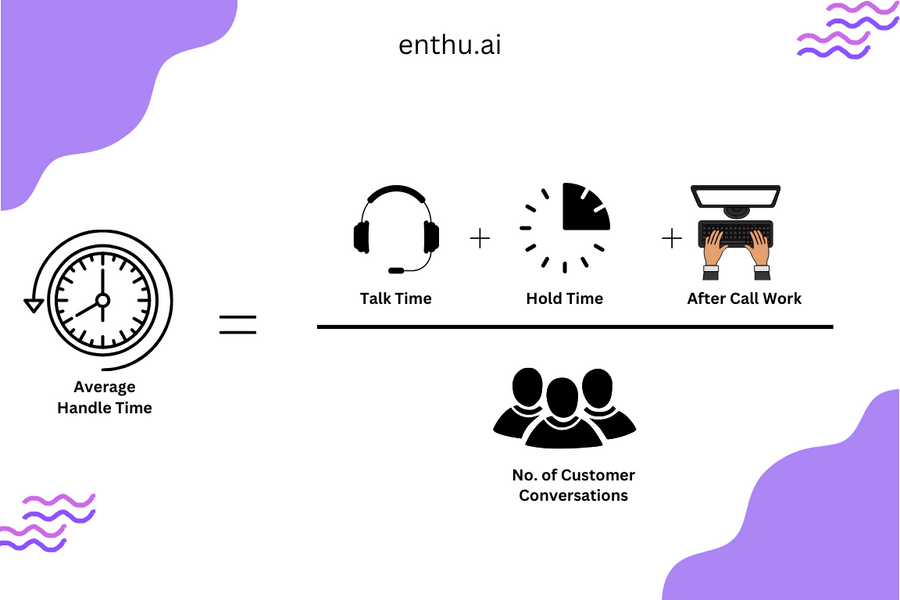
Where:
- Total Talk Time = total duration of all customer interactions (calls, chats, emails, etc.)
- After-Call Work Time = time spent on activities related to the interaction after the interaction has ended (e.g., documenting, researching, etc.)
- Number of customer conversations = total number of customer interactions handled.
- Average handle time example: A customer service call with a talk time of 10 minutes, 2 minutes on hold, and 5 minutes for post-call work results in an Average Handle Time of 17 minutes.
C. How to reduce average handle time?
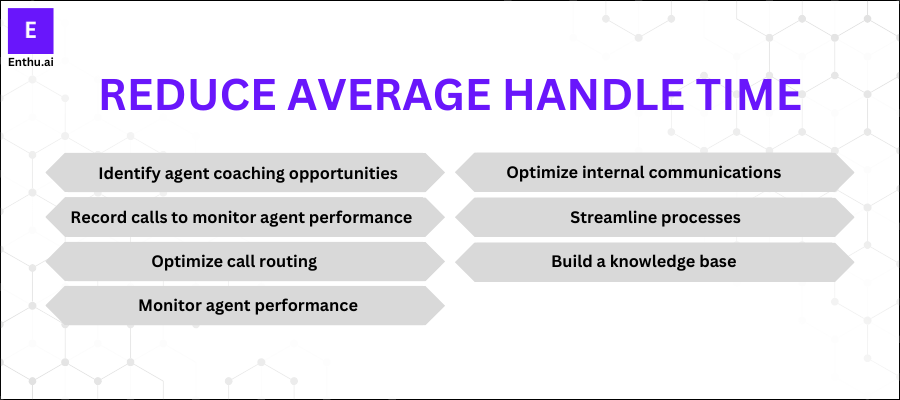
1. Identify agent coaching opportunities
Agents are responsible for handling customer issues.
You need to ensure agents are well-trained to handle them.
Proper and comprehensive training of agents will make sure that the average handle time is reduced.
Agents need to be well-versed with call center software, CRM, business tools, computer and headset, helpdesk, etc.
They also should know about the product/service and be well-versed with the terminology.
Case Study

2. Record calls to monitor agent performance
Call centers should use call recording tools to understand how agents performed during the calls.
It helps to identify inefficiencies and problems that arise during the course of the call, and also find out areas where there is a need for improvement.
Also, you will understand how customers react after a long wait on the call, how they engage during the call, and what the customer experience as a whole was.
You can use conversation intelligence software like Enthu.ai, which monitors every call and provides you with insights without listening to a single call.
3. Optimize call routing
Call centers must have a defined system in which agents know the right agent to whom they have to route calls.
When you transfer calls to the wrong agents, it only leads to excessive hold times, i.e, loss of valuable time for the customers. It only deteriorates customer experience.
Proper call routing ensures that agents are connected to the right agents in the first attempt, and it also improves the average handle time.
4. Optimize internal communications
Agents should be able to communicate with other agents easily. Avoid using slow email communications or having a third-party app to communicate with fellow agents.
Call centers must enable internal agent chat systems for effective internal communications, and this will result in higher customer satisfaction.
5. Streamline processes
Streamlining the agent workforce and processes is a great way to reduce the average handle time.
You must monitor the tasks that agents are doing and eliminate any task that is contributing to the increase in average handle time.
Agents must perform only that work that cannot be performed by anyone else. All other work should be automated so that the team can be the best at what they do.
6. Monitor agent performance
Performance of the agents must be monitored on a regular basis.
One of the ways to monitor agent performance is by using call monitoring software.
The software will help you listen to live calls without the agent knowing and conference in to talk with both agents and customers between the calls.
This is important for training purposes, which improves call center KPIs, call center statistics, and reduces call center attrition.
According to Mckinsey advanced analytics helps call centers proactively reduce average handle time.
7. Build a knowledge base
Building a knowledge base can help agents to acquirethe knowledge that they want in an instant.
It helps them to solve customer issues quickly without making customers wait for long, which helps in building brand sentiment.
Hence, it increases customer satisfaction and decreases handle time.
D. What is the importance of AHT?

Solving customer issues efficiently and effectively helps you gain customers’ loyalty.
That’s why average handle time is an essential metric because it helps you understand how quickly agents are solving customer issues.
Also, reducing your AHT means productivity gains.
It shows that your agents are performing better and the customers are getting their queries solved quickly, ultimately impacting the overall customer experience.
This also reflects in scores like CSAT, Net Promoter Score (NPS), and customer reviews.
1. Customer Satisfaction
AHT helps in measuring the time a customer spends on a call with the support team, which can be used to assess the quality of customer service and improve customer satisfaction.
2. Agent Performance
AHT is a crucial metric in evaluating agent performance and helps in identifying areas for improvement and training needs.
3. Resource Allocation
AHT data provides insights into how long agents take to resolve specific issues, which can be used to optimize resource allocation and improve overall efficiency.
4. Cost Savings
By reducing AHT, companies can reduce the cost of operation and increase profitability.
5. Quality Assurance
Average handle time data can be used to monitor and improve the quality of support services, ensuring that customers receive efficient and effective support.
6. Customer Experience
Reducing AHT can improve the customer experience by reducing wait times and improving the speed of resolution.
Read this blog: Call Center Quality Assurance Metrics: 13 Essential KPIs
E. What is “good” average handle time?
There cannot be a defined “good” average handle time as it would differ for every organization, for every process.
Average handle time depends upon the structure of the organization, the products/services they offer and what a company thinks is a good customer experience.
Instead of focusing too much on the metric, focus on the impact that you want to accomplish using AHT as the KPI
- Quickly solve customer issues
- Do not make customers hold for too long
- Increase per agent throughput for calls handled
- Improve customer satisfaction
But remember that solving customer issues quickly should not come at the expense of the customer being dissatisfied with your response.
So, stay focused on resolving the customer issue first.
F. Standard average handle time
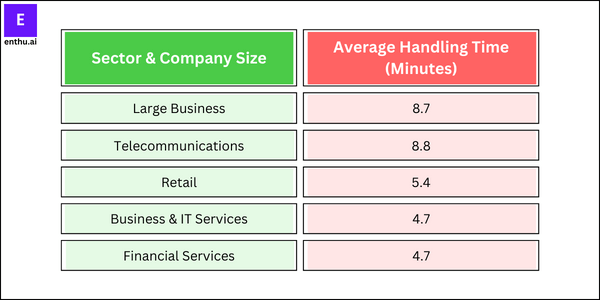
The industry benchmark for Average Handle Time (AHT) varies across different industries and the type of support being offered.
However, the standard AHT for a call center is typically considered to be around 5 to 7 minutes.
According to research, the average AHT for inbound customer service call centers is around 6 minutes.
However, this can vary greatly depending on factors such as the complexity of the issue, the skills of the agent, and the size of the call center.
It is important to note that while AHT is a key metric, it should not be the only focus of a call center.
Balancing AHT with other metrics such as First Call Resolution (FCR) and Customer Satisfaction (CSAT) is crucial in providing high-quality customer service.
The report by Cornell University tracks AHT by company size and sector:
G. What are the benefits of improved average handle time?
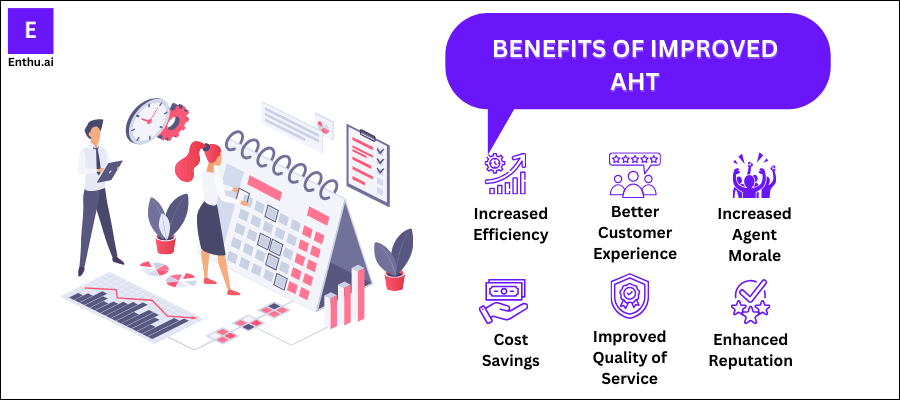
1. Increased Efficiency
Lowering AHT leads to more calls handled and faster resolution of customer issues, leading to increased efficiency and productivity.
2. Better Customer Experience
Improved AHT can reduce wait times for customers, providing them with a faster and more efficient support experience.
3. Increased Agent Morale
Agents will be able to handle more calls and resolve issues more quickly, which can lead to increased job satisfaction and morale.
4. Cost Savings
By reducing AHT, companies can reduce the cost of operation, increase profitability, and improve the bottom line.
5. Improved Quality of Service
Lower AHT improves the quality of support services, ensuring that customers receive efficient and effective support.
6. Enhanced Reputation
Improved AHT can enhance a company’s reputation and reduce customer churn rate by providing high-quality customer service and support.
Conclusion
Average handle time is an essential metric when it comes to understanding customer experience.
Aim to reduce the average handle time because not only does it improve customer satisfaction, but it also leads to reduced costs.
But you should also remember that solving customer issues quickly should not leave the customers dissatisfied.
Therefore, resolving customer issues efficiently and effectively should be your goal.
FAQs
1. How do you calculate average hold time?
Calculating average talk time is not that hard, especially if you know how to use a calculator. Just look at the number of calls you make and divide that number by the time period you are looking at to get average talk time.
2. What is AHT and its formula?
AHT (Average Handle Time) refers to the overall time an agent spends on a call, including talk time and after-call work. The formula is: AHT = (Total Talk Time + Total After-Call Work) / Total Number of Calls.
3. What is ASA in WFM?
ASA (Average Speed of Answer) in WFM (Workforce Management) measures the average time taken by an agents to answer calls. It assess the call center efficiency.
4. What is handling time?
Handling time is the total amount of time an agent spends dealing with a customer query, including talk time, hold time, and post call tasks, which is critical in determining efficiency.
5. What is average handling time in BPO?
Average handling Time (AHT) in BPO (Business Process Outsourcing) refers to the average amount of time an agent spends handling a customer interaction, including talk time and any related tasks.