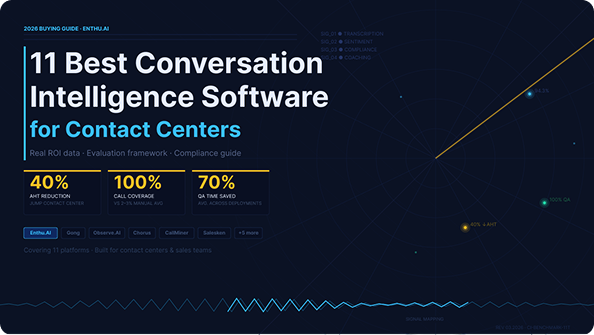
Most teams that buy conversation intelligence software don’t fail because they chose the wrong vendor. They fail because they chose a tool built for sales teams when they needed one built for contact centers, or vice versa.
The two use cases look similar on the surface, but demand completely different things from a platform.
A sales team needs deal intelligence and pipeline visibility, typically across 15-50 recorded conversations per agent per week. A contact center operates at an entirely different scale: a 100 seat phone team can generate upwards of 40,000 to 50,000 interactions per month (Salesforce, State of Service Report 2024), based on the industry benchmark of 40-50 calls per agent per day. The QA requirements, compliance obligations and coaching workflows that follow from this volume are fundamentally different from anything a sales-focused tool is designed to handle.
In the last 5 years, I have personally spoken to 1000+ teams as part of their CI software evaluation: most were already on a software and looking to switch. I had a direct window into what actually frustrates buyers about their current intelligence tools, what they wish existed and where vendor marketing diverges from real-world impact.
This guide is built on my firsthand experience, cross referenced against G2 review analysis across 10,000+ verified user reviews: 11 platforms, real data, honest pros and cons, and a buying framework that works whether you’re running a 10-person sales team or a 300-seat contact center. No paid placements. No sponsored rankings.
What you’ll find in this guide: A structured evaluation framework, head-to-head feature comparison, real ROI data from deployed teams, compliance guidance, implementation timeline, and honest assessments of when each tool wins, and when it doesn’t.
How we selected these tools: We evaluated platforms based on hands-on testing, G2/Capterra review analysis (10,000+ reviews aggregated), direct customer interviews, and real deployment data from contact centers and sales teams using these tools in production. Tools are ranked based on fit for each use case, not paid placement.
What is Conversation Intelligence Software?
As per IBM, Conversation intelligence uses AI and machine learning to automatically record, transcribe, and analyze customer conversations phone calls, video meetings, chat etc. and surface actionable business insights from that data.
Unlike basic call recording, which simply stores audio, conversation intelligence actively processes every interaction. It identifies sentiment, tracks keywords, flags compliance issues, scores agent performance, detects competitor mentions, and connects conversation patterns to business outcomes like deal close rates or customer churn.
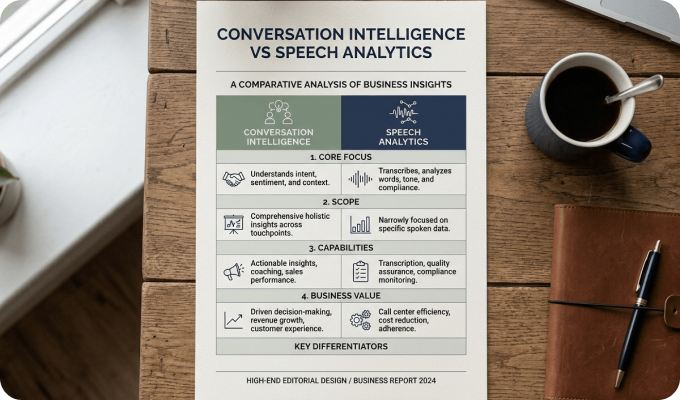
The core difference from speech analytics: Speech analytics detects keywords and transcribes audio. Conversation intelligence goes further, it understands context, identifies patterns across thousands of calls, and plugs insights directly into coaching workflows. Think of speech analytics as the engine and conversation intelligence as the full car.
👉 Deep dive: What is Conversation Intelligence? Complete 2026 Guide
The technology combines several AI capabilities: automatic speech recognition (ASR), natural language processing (NLP), sentiment analysis, speaker diarization, and machine learning models trained on sales and service conversations. The result: 100% call coverage at a fraction of the cost of manual review.
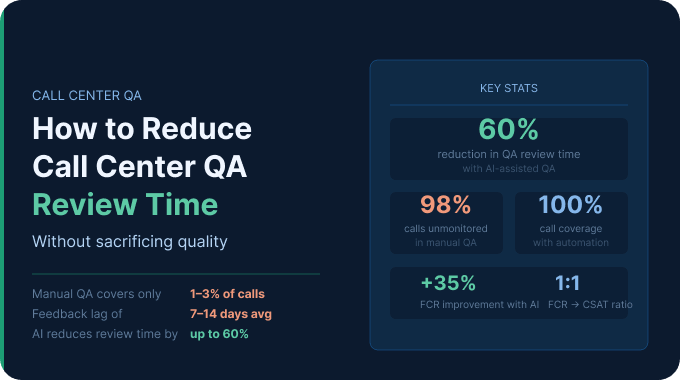
2-3%
Calls reviewed by teams manually – without AI.
It jumps to 95% with automation (McKinsey, Nov 2025)
40×
faster QA with automated conversation intelligence vs manual scoring.
(based on 100+ Enthu.AI deplyments across customers)
Contact Center CI vs. Sales Team CI: Key Differences
This is the split that most buying guides ignore, and it’s the single biggest reason teams end up with software that doesn’t fit. Contact center CI and sales team CI share a common technology base but serve completely different workflows.
CI for Contact Centers | CI for Sales Teams |
1. Primary goal: QA at scale, compliance, CSAT 2. Auto-score 100% of agent calls against QA scorecards 3. Flag compliance violations in real time 4. Monitor script adherence and regulatory keywords 5. Track CSAT drivers across every interaction 6. Identify coaching moments for frontline agents 7. Support inbound and outbound call flows 8. Handle high-volume teams (50–5,000+ agents) 9. PII redaction from transcripts Best tools: Enthu.AI, Observe.AI, CallMiner | 1. Primary goal: Deal with intelligence, rep coaching 2. Track deal health from call signals 3. Detect competitor mentions and objections 4. Analyze talk: listen ratios and rep behavior 5. Connect call data to CRM pipeline stages 6. Coach reps on specific high-value moments 7. Forecast accuracy from conversation signals 8. Video + phone meeting analysis 9. Sales rep self-coaching workflows Best tools: Gong, Chorus, Avoma, Salesken |
Many teams need both. Enthu.AI is one of the few platforms purpose-built to serve both use cases, contact center QA and sales team coaching, from a single platform without the enterprise-level price tag of Gong or Observe.AI.
Full guide: How to Choose the Best Conversation Intelligence Software.
What RoI Can You Realistically Expect from Conv. Intelligence Software?
Before evaluating tools, it helps to benchmark what realistic outcomes look like. Here’s what teams deploying conversation intelligence have achieved, not marketing projections, but reported results from real deployments.
Enthu.AI Customer Results – Real Deployment Data
40% Reduction in Average Handle Time (AHT) | 100% SLA adherence achieved after deployment Jump Contact Center | 50% Improvement in lead qualification rate
US Real Estate Team | 70% Reduction in manual QA review time Multiple customers, avg across deployments |
These outcomes aren’t guaranteed; they depend on your baseline, team size, and how actively you use the coaching workflows. But they establish a realistic ceiling for what conversation intelligence can deliver when deployed well.
The underlying driver: most teams manually review 2–3% of calls. Conversation intelligence analyzes 100% automatically. The jump from 3% to 100% coverage is where most of the value lives.
What are the Best Conversation Intelligence Platforms in 2026?
We evaluated 20+ platforms and narrowed to 11 based on feature depth, real user reviews, pricing transparency, and fit for each use case. Each tool below includes our honest assessment, including where it falls short.
1. Enthu.AI
Best for: Contact centers, SMB sales teams, QA-focused organizations, B2B, collections
Enthu.AI uses advanced NLP and machine learning to deliver conversation intelligence built specifically around contact center QA and sales team coaching. The platform automatically monitors every interaction, applies custom QA scorecards, and delivers agent-level coaching insights, all without hours of manual review.
What sets it apart is the combination of contact center-grade QA automation with sales coaching features, at pricing that SMBs and mid-market companies can actually afford.
✓ Contact Center QA ✓ Sales Coaching ✓ Real-time Alerts ✓ Auto QA Scoring, SMB + Mid-Market
Key capabilities: 100% call monitoring, custom QA scorecards, sentiment analysis, call transcription, auto-generated coaching playlists, PII redaction, agent performance dashboards, call alerts, and call summaries. The platform works across phone, Zoom, Teams, and major VoIP platforms.
✓ Strengths | ✗ Limitations |
|
|
Best for: Contact centers, SMB sales, D2C, collections, appointment setters
Pricing: Custom pricing / (Free demo available)
Integrations: Zoom, Teams, Aircall, JustCall, HubSpot, Salesforce, RingCentral
2. Gong
Best for: Enterprise sales teams, revenue intelligence, pipeline forecasting
Gong is the market leader for enterprise revenue intelligence. It analyzes sales calls, emails, and meetings to give revenue teams deep visibility into deal health, rep behavior, and pipeline risk. If you’re running a 50+ person AE team and need deal-level AI insights connected to your CRM, Gong is the gold standard, at a premium price.
✓ Revenue Intelligence ✓ Deal Risk Detection ✓ Multi-channel (calls + email) Enterprise
✓ Strengths | ✗ Limitations |
|
|
Best for: Enterprise B2B sales, revenue operations
Pricing: Custom Pricing
3. Chorus by ZoomInfo
Best for: Sales enablement, meeting intelligence, ZoomInfo customers
Chorus is a strong mid-market sales CI platform, particularly powerful for teams already using ZoomInfo for prospecting. It captures and analyzes calls and meetings, with solid coaching and onboarding features. Its biggest advantage is native ZoomInfo integration that connects prospect intelligence with conversation data.
✓ Meeting Intelligence ✓ Sales Enablement Mid-Market
✓ Strengths | ✗ Limitations |
|
|
Best for: Sales teams using ZoomInfo
Pricing: Custom enterprise pricing
4. Observe.AI
Best for: Enterprise contact centers, real-time agent assist
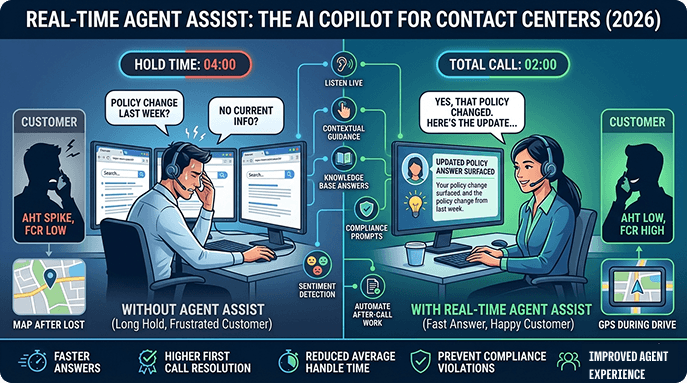
Observe.AI is the enterprise choice for large contact centers that need both post-call analysis and real-time agent guidance. Its AI listens during live calls and surfaces relevant information, scripts, and compliance warnings to agents as the conversation happens. Strong compliance focus makes it popular in regulated industries (financial services, healthcare, insurance).
✓ Real-time Agent Assist ✓ Compliance Focus ✓ Enterprise Contact Center Enterprise
✓ Strengths | ✗ Limitations |
|
|
Best for: 200+ seat contact centers in regulated industries
Pricing: Custom pricing
5. Salesken
Best for: Real-time sales guidance, objection handling, inside sales
Salesken‘s unique differentiator is its real-time approach; the AI listens to calls as they happen and shows reps live cue cards for objection handling, competitor responses, and script adherence. For teams whose reps regularly struggle with specific objection patterns or price resistance, this real-time coaching is genuinely valuable.
✓ Real-time Cue Cards ✓ Objection Handling, Inside Sales
✓ Strengths | ✗ Limitations |
|
|
Best for: Inside sales teams with high objection volume
Pricing: Contact for pricing
6. CallMiner Eureka
Best for: Enterprise contact centers, omnichannel analytics, compliance-heavy industries
CallMiner Eureka is a heavyweight enterprise platform focused on transforming unstructured conversation data across every touchpoint into clean, actionable intelligence. Strong in compliance, risk management, and omnichannel analytics (voice + chat + email). A preferred choice for large financial services and insurance contact centers.
✓ Omnichannel ✓ Risk & Compliance, Enterprise
✓ Strengths | ✗ Limitations |
|
|
Best for: Large contact centers, financial services, insurance
Pricing: Custom enterprise pricing
7. Avoma
Best for: Meeting-heavy sales cycles, SMB revenue teams, collaborative note-taking
Avoma combines AI meeting notes, agenda management, and conversation intelligence into a unified platform. It’s particularly strong for B2B sales teams with long, relationship-driven sales cycles where meeting quality and follow-through matter as much as call volume. Starting at around $19/user/month, it’s one of the most accessible CI platforms available.
✓ AI Meeting Notes ✓ Collaborative SMB From ~$19/user
✓ Strengths | ✗ Limitations |
|
|
Best for: SMB B2B sales teams, meeting-heavy workflows
Pricing: From ~$19/user/month
8. Wingman (by Clari)
Best for: Real-time sales coaching, Clari pipeline users
Wingman (now part of Clari) provides real-time battle cards, competitor alerts, and talk-track coaching during live sales calls. The Clari acquisition means tighter pipeline and forecasting integration for teams already on that platform.
✓ Strengths | ✗ Limitations |
|
|
Best for: Clari-using sales teams
Pricing: Contact for pricing
9. ExecVision
★ 4.3/5(G2)
Best for: Sales coaching-focused teams, manager-driven performance improvement
ExecVision focuses intensely on the human coaching workflow, not just flagging call moments, but building structured manager-to-rep coaching sessions around them. Strong for organizations where coaching cadence and accountability are the primary goals.
✓ Strengths | ✗ Limitations |
|
|
Best for: Sales coaching programs, performance management
Pricing: Contact for pricing
10. Jiminny
Best for: European B2B sales teams, GDPR-compliant deployments
Jiminny is a conversation intelligence platform with strong roots in the UK and European market. Its GDPR-native architecture makes it a preferred choice for European sales teams concerned about data residency. Solid call recording, transcription, and coaching features at competitive pricing.
✓ Strengths | ✗ Limitations |
|
|
Best for: European B2B sales, GDPR-sensitive organizations
Pricing: Contact for pricing
11. Refract (by Allego)
Best for: Sales enablement integration, video coaching, enterprise training programs
Refract (now part of Allego) connects conversation intelligence directly to a full sales enablement and training platform. Useful for large organizations that want to build a direct pipeline from call analysis to formal training content and certification programs.
✓ Strengths | ✗ Limitations |
|
|
Best for: Allego customers, formal enterprise training programs
Pricing: Custom enterprise
How do the Top Conversation Intelligence Software Compare?
A quick-reference breakdown of the top platforms across the features that matter most for contact centers and sales teams.
Platform | Contact Center QA | Sales Coaching | Real-time Assist | Auto Scoring | PII Redaction | SMB Pricing | G2 Rating |
Enthu.AI | ✓ Strong | ✓ Strong | △ | ✓ | ✓ | ✓ | 4.9/5 |
Gong | Limited | ✓ Best-in-class | △ | ✓ | ✓ | ✗ Enterprise only | 4.7/5 |
Observe.AI | ✓ Best-in-class | △ Basic | ✓ Best-in-class | ✓ | ✓ | ✗ Enterprise only | 4.6/5 |
Chorus | ✗ | ✓ Strong | △ | ✓ | ✓ | ✗ | 4.5/5 |
Salesken | △ | ✓ | ✓ Strong | △ | △ | ✓ | 4.9/5 |
CallMiner | ✓ Strong | △ | ✓ | ✓ | ✓ | ✗ | 4.5/5 |
Avoma | ✗ | ✓ | △ | △ | △ | ✓ From $19 | 4.6/5 |
✓ Strong/Full support △ Partial/Limited ✗ Not available.
How to Choose the Right Connversation Intelligence Softw2are?
After helping dozens of teams select and deploy CI software, we’ve distilled the evaluation into seven criteria that separate the right fit from a costly mistake. Work through these before you shortlist.
Criterion 01
Use Case Fit First
Are you primarily running a contact center (QA + compliance focus) or a sales team (deal intelligence + coaching)? This single question should eliminate half the vendors immediately. Don’t buy a sales CI tool for a contact center, the workflows, integrations, and success metrics are fundamentally different.
Criterion 02
Transcription Accuracy for Your Calls
Platform accuracy claims are often measured on clean, studio-quality audio. Test with your actual calls, your dialect, your accents, your background noise, your industry jargon. Request a sample transcription during the trial. A 10% accuracy difference at scale translates to thousands of miscategorized calls per month.
Criterion 03
Integration with Your Stack
Map your current VoIP/dialer, CRM, and video platform. The CI tool must have native, maintained integrations, not just API access that requires dev work. Verify the integration works bidirectionally (pushing insights back into your CRM, not just pulling call data).
Criterion 04
Pricing Model Transparency
Understand the full cost structure: per-user fees, platform fees, storage costs, API call costs, and overage charges. Some platforms look cheap per-user but add a $2,000+/month platform fee. Ask for a fully loaded annual cost projection before you sign.
Criterion 05
Time to Value
How fast can you get from contract-signed to first insights? Enthu.AI customers are live in hours. Enterprise platforms like CallMiner or Observe.AI can take 4–12 weeks to configure. If your team needs quick wins to justify the investment, weigh this heavily.
Criterion 06
Security & Compliance Certifications
Verify SOC 2 Type II at a minimum. If you’re in healthcare, check HIPAA BAA availability. If you’re in financial services, ask about PCI-DSS and call redaction capabilities. If you’re EU-based, confirm data residency options and GDPR processing agreements.
Criterion 07
Adoption & Change Management Support
The #1 reason CI implementations fail isn’t bad technology; it’s low adoption. Ask vendors: what’s their onboarding process? Do they have a customer success playbook? What percentage of their customers reach 80%+ call coverage within 90 days? A vendor who can answer this confidently has seen enough deployments to have learned from failures.
Quick shortcut: If you’re running a contact center with 20–500 agents and need QA automation + coaching without enterprise complexity or pricing, Enthu.AI is purpose-built for this use case. Read the full evaluation guide.
How much does a CI software cost in 2026?
What most conversation intelligence software require a demo call to get a ballpark, here’s what we know from public sources, customer interviews, and the market data.
Platform | Pricing Model | Approx. Entry Price | Platform Fee | Best Value For |
Enthu.AI | Usage based | $6 per hour of analysis | None | SMB/Mid-market |
Avoma | Per user/month | ~$19/user/month | No | Very small teams |
Gong | Per user + platform | ~$1,200–1,600/user/year | Yes (~$5,000+/year) | Best fit for B2B Sales teams |
Chorus | Per user + platform | Custom (est. $800–1,200/user/year) | Yes | ZoomInfo customers |
Observe.AI | Per agent + platform | Custom (est. $80–150+/agent/month) | Yes | 200+ seat contact centers |
CallMiner | Custom / volume-based | Custom | Yes | Enterprise CC |
Salesken | Per user/month | Contact for pricing | Unclear | Inside sales teams |
Pricing estimates based on public information and user-reported data. Always verify directly with vendors. Prices change frequently.
Which Tool Does a CI Software Integrate With?
Your CI platform is only as good as its integrations. A tool that can’t talk to your VoIP system is useless; one that doesn’t push insights back into your CRM leaves half the value on the table.
VoIP & Dialer Integrations (Enthu.AI)
Aircall, JustCall, RingCentral, Dialpad, CloudTalk, Talkdesk, Five9, NICE inContact, Twilio, Vonage
Video Platforms
Zoom, Microsoft Teams, Google Meet, Webex
CRM & Helpdesk
Salesforce, HubSpot, Pipedrive, Zoho CRM, Zendesk, Freshdesk
Integration pro tip: Always verify that integrations are native and maintained, not just listed. Ask vendors: “When was this integration last updated? Is it bidirectional?” Broken integrations are the most common source of post-deployment frustration reported in G2 reviews.
Is It Legal to Record Calls? A Compliance Guide For CI Software Users
Before deploying any conversation intelligence platform, you need to understand the call recording laws in your jurisdiction. Non-compliance isn’t just a legal risk, a single regulatory penalty can dwarf your annual CI software cost.
Important: This is general information, not legal advice. Consult your legal team for jurisdiction-specific guidance before deploying.
US Call Recording Laws
One-party consent states (majority of US): Only one party to the call needs to consent. Since your employee is a party, internal business recording is generally permitted without disclosing to the customer, though best practice is always to disclose anyway.
All-party (two-party) consent states include: California, Connecticut, Florida, Illinois, Maryland, Massachusetts, Michigan, Montana, Nevada, New Hampshire, Oregon, Pennsylvania, and Washington. In these states, ALL parties must consent to recording. You must announce the recording at the start of every call.
International Considerations
- GDPR (EU/EEA): Requires a lawful basis for processing (typically legitimate interest or explicit consent). Mandatory disclosure. Data subject rights (access, deletion) apply to recordings. Data residency requirements may apply.
- CCPA (California): Customers can request deletion of their conversation data. Disclose data collection in your privacy policy.
- HIPAA (US Healthcare): If calls contain Protected Health Information (PHI), you need a Business Associate Agreement (BAA) with your CI vendor and strict data handling controls.
- PCI-DSS: Credit card numbers spoken on calls must be redacted from recordings. Verify your CI platform has automatic PCI redaction.
Best Practice: Always Disclose
Regardless of jurisdiction, starting every call with “This call may be recorded for quality and training purposes” is the safest approach it satisfies all-party consent requirements, sets customer expectations, and reduces legal risk universally.
Related: How to evaluate CI software for compliance requirements
How Long Does It Take to Implement Conversation Intelligence Software?
One of the most common questions buyers ask: “How long before we see real ROI?” Here’s a realistic week-by-week timeline based on 100+ deployments we have done at Enthu.AI, and the milestones that matter.
Week 1–2
Technical Setup & Integration
Connect your VoIP/dialer and CRM. Configure call ingestion. Set up user roles and permissions. First calls are captured and transcribed. Most teams reach full technical go-live within 1–10 business days.
Week 1–3
QA Scorecard Configuration
Build your first QA scorecards aligned to your quality standards. Define keyword libraries (competitor mentions, compliance triggers, objection patterns). Run first batch of auto-scored calls. QA team starts reviewing AI scores vs. the manual baseline.
Week 3–4
First Coaching Insights
Managers receive the first agent performance dashboards. Identify the top 3 coaching opportunities from the call data. Build first coaching playlists with example calls. Begin weekly coaching cadence using conversation data.
Month 2
Workflow Integration & Adoption
CI insights become part of the daily/weekly ops rhythm. Agents receive regular feedback tied to specific call moments. QA coverage jumps from 3–5% (manual) to 80–100% (automated). First measurable QA score improvements are typically visible.
Month 3
Measurable ROI Baseline
Establish before/after metrics: AHT, call quality scores, CSAT, conversion rates, and compliance adherence. Teams at this stage typically see 20–40% QA time reduction, meaningful call quality score improvement, and faster new-hire ramp through targeted coaching playlists.
Implementation red flag: If a vendor talks about a “6-12 months configuration and integration time”, that’s a serious adoption risk.
As quoted by Alex McConville from Yopa, one of the flagship Enthu.AI Customers: Modern CI platforms should be live in days to weeks, not quarters.
Frequently Asked Questions (FAQ)
1. What is the difference between Call Recording and Conversation Intelligence?
Basic call recording simply stores audio files for manual review. Conversation Intelligence (CI) uses AI and Natural Language Processing (NLP) to transcribe those calls, analyze speaker sentiment, identify key deal inhibitors, and sync actionable insights directly into your CRM without human intervention.
2. Is Conversation Intelligence legal in “Two-Party Consent” states?
Yes. In US states like California, Florida, and Illinois, you must notify participants that they are being recorded. Most CI platforms handle this automatically by playing an audio prompt, displaying a visual recording disclaimer in the meeting room, or using a “recording bot” that clearly identifies itself.
3. How does Conversation Intelligence improve sales win rates?
CI improves win rates by identifying the specific behaviors of “A-Players.” Managers can see exactly which discovery questions, talk-to-listen ratios, and objection-handling techniques lead to closed deals, then use those “game tapes” to coach the rest of the team to the same standard.
4. Can CI software integrate with Salesforce and HubSpot?
Absolutely. Top-tier providers like Gong, Chorus, and Salesloft offer native, deep integrations. They don’t just link the call; they automatically update deal stages, populate custom fields based on the conversation, and trigger follow-up tasks for the sales rep.
5. Does Conversation Intelligence work for remote and hybrid teams?
It is arguably most valuable for remote teams. Since managers can’t “walk the floor” to hear live pitches, CI provides a digital floor where leaders can review snippets of calls asynchronously and provide feedback via comments directly on the transcript.
6. What is “Sentiment Analysis” in the context of CI?
Sentiment analysis uses AI to detect the emotional tone of a conversation. It can flag if a prospect is becoming frustrated, if they sound genuinely excited about a feature, or if there is a sudden shift in “buying signals” that suggests the deal might be at risk.
7. How much does Conversation Intelligence software typically cost?
Pricing varies significantly by scale. Enterprise solutions like Gong or Chorus usually range from $1,200 to $1,600 per user per year with a platform fee. However, SMB-focused tools or “lite” versions can start as low as $30 to $50 per month, or even offer free basic meeting summaries.
8. Can this software help with HIPAA or SOC2 compliance?
Yes. Most leading USA-based CI vendors are SOC2 Type II compliant. For healthcare organizations, many offer HIPAA-compliant processing that includes automated “PII Redaction,” which strikes out sensitive patient or financial information from the transcripts automatically.
9. Will AI-generated summaries replace manual sales notes?
In 2026, AI summaries have reached a level of accuracy (95%+) where manual note-taking is becoming obsolete. These summaries are designed to capture “Action Items,” “Next Steps,” and “Pain Points,” allowing the rep to be 100% present and engaged with the prospect.
10. How long does it take to see ROI from a CI implementation?
Most organizations see a “Time to Value” within 30 to 60 days. Initial ROI usually comes from reduced onboarding time for new hires, followed by a measurable increase in “Discovery-to-Demo” conversion rates as the team adopts the platform’s AI-driven coaching insights.


 On this page