Key Takeaways
- Complete call coverage: Speech analytics analyzes every single call automatically, not just a random 1-3% sample, giving you a complete, unbiased picture of every customer interaction.
- Real-time issue resolution: Real-time sentiment alerts help you resolve issues on the spot, detecting customer frustration mid-call so your team can step in before satisfaction takes a hit.
- Smarter agent coaching: Agent coaching becomes faster and more targeted because feedback is backed by real call evidence, not manager instinct or guesswork.
- Effortless compliance monitoring: Compliance monitoring runs on autopilot, flagging missed disclosures, regulatory breaches, and risky language across every conversation without manual effort.
- Revenue intelligence from every call: Every conversation becomes a source of revenue intelligence, identifying what your best agents say, how they say it, and how to replicate that success across your entire team.
You already know customer experience is everything. But are you actually using the data from every conversation to drive it?
Here are the 7 ways speech analytics delivers real value fast:
- Improves customer satisfaction and real-time experience
- Elevates agent performance through evidence-based coaching
- Drives operational efficiency and reduces costs
- Automates compliance monitoring and risk management
- Fuels data-driven revenue and sales growth
- Reduces customer churn before it happens
- Delivers a measurable, lasting competitive advantage
In this guide, you’ll discover all 7 key benefits of speech analytics for call centers, what to look for in a solution, the top use cases, and a clear implementation roadmap.
Upload Call & Get Insights
 DOWNLOAD DUMMY FILE
 Table of Contents
A. What is speech analytics?
Speech analytics is a technology that automatically analyzes recorded or live customer calls, converting unstructured voice data into structured, actionable intelligence.
It uses Automatic Speech Recognition (ASR) to transcribe conversations, then applies Natural Language Processing (NLP), sentiment analysis, and AI-powered pattern detection to extract meaningful insights.
Why does speech analytics matter?
Here is a striking reality: less than 1-3% of contact center calls are manually reviewed. That means the vast majority of your customer intelligence, complaints, trends, opportunities, and risks go completely unnoticed. Speech analytics changes that entirely by analyzing 100% of your calls, automatically.
The global speech analytics market was valued at $4.94 billion in 2025 and is projected to grow to $15.31 billion by 2034. That growth reflects one thing: businesses worldwide are realizing what they’ve been missing.
Key components of speech analytics
- Automatic speech recognition (ASR): Converts spoken words into searchable, machine-readable text instantly.
- Natural language processing (NLP): Interprets the meaning, context, and intent behind customer words.
- Sentiment analysis: Detects emotional tone like frustration, satisfaction, and urgency.
- Keyword & phrase spotting: Flags compliance signals, churn language, and sales intent terms.
- Real-time analytics: Delivers live coaching prompts and alerts during active calls.
- Post-call analytics: Reviews historical call data to identify trends and gaps.
Real-world example
Yopa, a UK’s leading hybrid estate agencies, managing 8,000 calls per month implemented Enthu.AI’s speech analytics and achieved a 19% improvement in agent compliance scores and a 17% reduction in call handling time.
Quality audits that once consumed entire workdays were completed in minutes. Speech analytics surfaced recurring customer objections and confusion points, enabling team leaders to deliver targeted coaching that significantly improved first-call resolution rates.
Read the full case study here.
“You can pick Enthu.AI in a few hours, unlike our previous speech analytics partner that took 6 months to configure.” – Alex McConville.
B. 7 benefits of speech analytics for call centers
When implemented effectively, speech analytics benefits can transform your contact center from reactive to proactive. By turning every conversation into a source of intelligence, it empowers leaders to improve customer experience, enhance agent performance, and streamline operations, all while driving revenue growth.
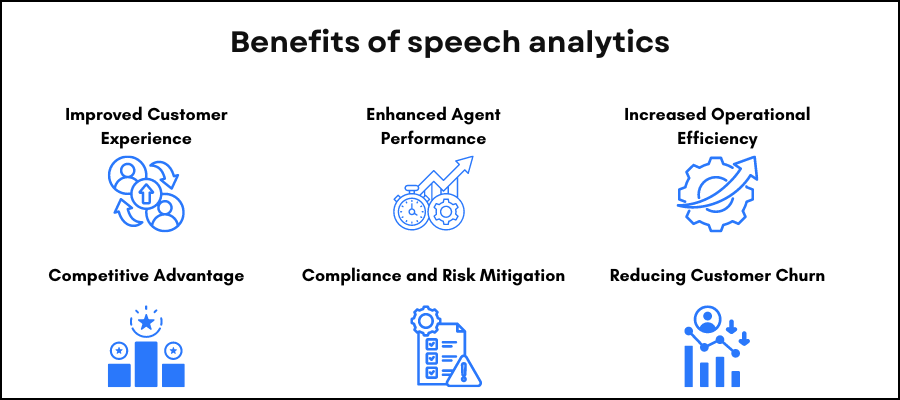
Below are the top 7 key speech analytics benefits:
1. Improved customer experience
Speech analytics gives you a real-time view of how customers feel and the ability to act on it immediately.
It detects frustration, confusion, or dissatisfaction as it surfaces in a call, triggering instant supervisor alerts before a situation escalates. McKinsey data confirms that contact centers implementing speech analytics achieve a 10% or more improvement in CSAT scores.
How it improves your customer experience:
- Real-time sentiment alerts notify supervisors when a call is heading in the wrong direction
- Topic trend analysis surfaces the most common customer issues across thousands of calls simultaneously
- Personalization signals help agents adapt tone and approach to individual customer needs
- Root cause analysis identifies why customers keep calling back so you can fix the actual problem
Pro tip: Set up automated escalation alerts for calls where sentiment drops sharply. This single feature alone can recover relationships that would otherwise end in churn.
2. Enhanced agent performance
Speech analytics replaces guesswork-based coaching with precise, evidence-backed insights drawn from every single call.
Instead of reviewing a random 5% sample, managers can analyze 100% of interactions and pinpoint exactly where each agent excels or needs development. This makes coaching faster, more targeted, and significantly more effective.
What speech analytics reveals about agent performance:
- Communication gaps – hesitations, filler words, missed keywords, tone inconsistencies
- How individual agents compare to your top performers on key conversation metrics
- Adherence to approved scripts, required disclosures, and brand communication guidelines
- Improvement trends over time, tracked automatically without manual effort
Pro tip: Build a “best call” library using speech analytics. Let new agents learn directly from real examples of high-performing conversations not hypothetical training scenarios.
3. Increased operational efficiency
Speech analytics automates the most time-consuming parts of call center operations – categorization, summarization, and quality review.
It identifies bottlenecks, flags repetitive queries, and highlights process inefficiencies that managers would never catch through manual spot-checking alone. The result: your team operates faster, with fewer resources, and greater output.
Where operational gains show up:
- Automated call categorization and intelligent routing eliminate initial probing
- AI-generated call summaries reduce post-call admin time by up to 75%
- Identification of recurring queries creates opportunities for self-service deflection
- Process bottleneck analysis surfaces where agent workflows can be reengineered
“Speech analytics can reduce Average Handle Time (AHT) by 16% and improve customer satisfaction by 15-20%.” – Rezo.AI
4. Compliance and risk mitigation
Speech analytics automatically monitors every single call for compliance issues – flagging violations before they become regulatory incidents.
For industries like financial services, insurance, and healthcare, manual compliance monitoring is neither scalable nor reliable. Speech analytics closes that gap entirely, checking every call against your required protocols.
What automated compliance monitoring covers:
- Checks whether mandatory disclaimers and disclosures were read correctly
- Verifies that proper customer consent was obtained during the interaction
- Flags prohibited language, aggressive sales tactics, or regulatory breaches in real time
- Generates audit-ready compliance reports automatically without manual effort
Pro tip: Use compliance trend reporting monthly. A small pattern of missed disclosures across 100 agents can quickly become a significant regulatory liability if left undetected.
5. Competitive advantage through customer intelligence
Speech analytics reveals exactly what your customers want, what frustrates them, and what your competitors may be missing, straight from their own words.
By analyzing conversation patterns at scale, you uncover market trends, product feedback, and unmet customer needs that no survey or NPS score can capture. This turns your call center into a real-time market research engine.
How speech analytics builds competitive advantage:
- Identifies repeated product or service complaints that need urgent attention
- Tracks competitor mentions and comparative customer sentiment across your full call base
- Surfaces emerging customer expectations before they become industry-wide standards
- Converts raw voice data into strategic intelligence for product, marketing, and operations teams
Pro tip: Run monthly keyword trend reports to spot shifts in customer language. It’s an early warning system for product gaps your competitors haven’t addressed yet.
6. Reducing customer churn
Speech analytics identifies at-risk customers early, giving your team a window to act before those customers walk out the door.
It detects churn signals like frustration spikes, cancellation language, and repeated unresolved complaints, then triggers proactive alerts so agents or managers can intervene at the right moment.
How speech analytics reduces churn:
- Detects “churn language” like cancellation requests, dissatisfaction phrases, and competitive mentions
- Identifies root causes of repeat contacts and unresolved service issues
- Enables proactive outreach to at-risk customers before they disengage
- Reduces repeat calls and callbacks by addressing root causes at the source
7. Data-driven revenue growth
Speech analytics helps sales teams close more deals by revealing exactly what works in high-performing conversations and replicating it at scale.
By analyzing your best calls, it identifies the specific phrases, questions, pacing, and approaches that correlate with conversions. Then it helps your entire team replicate that success, not just your top performers.
How speech analytics drives revenue growth:
- Identifies high-intent language signals in real-time sales calls
- Surfaces common objection patterns so teams can prepare sharper responses
- Reveals upsell and cross-sell opportunities that agents missed during live conversations
- Links conversation intelligence directly to revenue metrics like SQL rates and close rates
“A mortgage provider using Enthu.AI achieved a 50% increase in sales-qualified leads and a 14% rise in closures after implementing speech analytics, transforming outcomes in months, not years.”
C. What things to consider when choosing a call center speech analytics solution?
The right speech analytics platform can transform your contact center; the wrong one creates data overload without actionable results.
Before committing to a vendor, evaluate these critical factors to ensure you choose a solution that fits your actual needs:
- Transcription accuracy – Look for 95%+ accuracy validated by third parties, not vendor self-reporting; accuracy matters most in noisy environments and with varying accents
- Real-time vs. post-call capabilities – The best platforms offer both: real-time for immediate coaching and post-call for strategic trend analysis
- Integration compatibility – Confirm seamless connection with your CRM, call recording platform, and workforce management tools via robust APIs
- Security and compliance standards – Verify GDPR, HIPAA, or SOC 2 compliance based on your industry before signing any agreement
- Pricing transparency – Understand whether costs are per user, per minute, or per call volume to calculate true total cost of ownership
- Onboarding and support quality – Prioritize vendors with structured implementation support, not just a login and a knowledge base
D. What are the top speech analytics use cases?
Speech analytics is versatile, it powers quality assurance, sales optimization, compliance management, and customer experience programs simultaneously.
Here are the most impactful use cases delivering measurable ROI across contact centers today:
- Quality Assurance (QA) – Automatically score 100% of calls instead of a manual 5-10% random sample, giving a complete performance picture
- Agent Coaching – Identify specific skill gaps and deliver targeted feedback backed by real call-level evidence, not assumptions
- Compliance Monitoring – Flag regulatory violations, missed disclosures, and non-compliant language automatically before they escalate
- Churn Prevention – Detect early dissatisfaction and cancellation language signals to trigger proactive retention workflows
- Sales Optimization – Analyze winning call patterns and build replicable playbooks your entire sales team can use
- Voice of Customer (VoC) – Capture unsolicited product feedback, market trends, and unmet needs directly from customer conversations
- First Call Resolution (FCR) Improvement – Identify why customers call back repeatedly and eliminate those root causes at the source
E. How to implement speech analytics in your contact center
Successful speech analytics implementation requires clear goals, the right platform, and a team equipped to act on the insights it surfaces.
Follow this 6-step roadmap to get results from day one:
- Define your goals first – Identify what you need to solve: compliance gaps, low CSAT, high AHT, or underperforming sales; clear goals prevent the project becoming a data collection exercise
- Choose the right platform – Evaluate tools on accuracy, integration capability, real-time features, and compliance certifications relevant to your industry
- Set data quality and privacy standards – Establish audio quality requirements and data privacy frameworks before processing any customer recordings
- Configure with your terminology – Train the AI using industry-specific keywords, compliance phrases, and business-relevant language patterns for maximum accuracy
- Run a focused pilot program – Start with one high-priority use case, measure results carefully, and refine your approach before scaling across the operation
- Act on insights consistently – Review reports regularly, update call scripts, reinforce winning behaviors in training, and track improvement metrics month over month
Conclusion
Benefits of speech analytics in contact center operations dives far more profound than just being a testament to cutting-edge technology. It serves as a calculated approach aimed at enhancing several aspects.
Among these key aspects are customer satisfaction levels, the performance metrics of agents, and the overarching operational productivity of the entire center.
Speech analytics projections provide an overall snapshot of the center’s operation – identifying bottlenecks, highlighting process inefficiencies, and suggesting optimization areas.
By enabling management to focus on these areas, it can lead to streamlining operations and reducing costs.
Ready to see speech analytics in action?
Get your free call audit with Enthu.AI today!
FAQs
1. Why is speech analysis important?
Speech analysis is essential because it helps companies understand how customers engage with them, identify trends, and enhance their communication tactics. It facilitates better decision-making by improving customer experience, ensuring compliance, training sales teams, and identifying trends.
2. What is speech analytics?
Speech analytics gathers valuable data by examining verbal interactions, such as customer calls. It provides actionable insights from conversations to help assess customer sentiment, pinpoint important issues, track agent performance, ensure compliance, and enhance overall service quality.
3. What are the benefits of speech technology?
- Enhanced Customer Support: The system provides agents with real-time information and automates call routing.
- Improved Accessibility: Voice-activated controls allow individuals with impairments to use the system.
- Enhanced Efficiency: Voice instructions speed up data entry and task completion.
- Actionable Insights: The system offers in-depth analysis of customer interactions to enable better decision-making.
- Savings: The system lowers operating costs and eliminates the need for manual processes.
- Multilingual Support: The system facilitates communication in multiple languages, extending its reach.