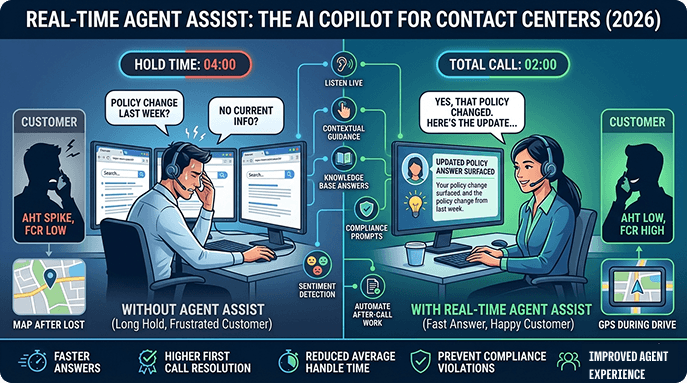
Your agent is on a live call. The customer asks a question about a policy that changed last week. The agent doesn’t know the answer. So they put the customer on hold, open three tabs, search the knowledge base, find nothing current, and finally message a supervisor on Slack. Four minutes of dead silence. The customer is annoyed. AHT just spiked. FCR just died.
Now, picture the same call with real time agent assist running. The AI listens to the conversation, recognizes the question, and surfaces the updated policy answer on the agent’s screen within seconds. No hold. No Slack. No frustrated customer. Call resolved in two minutes.
That’s not a future scenario. That’s what AI copilots in contact centers do right now in 2026.
What is Real-Time Agent Assist?
Real-time agent assist is AI software that listens to live customer conversations and provides agents with contextual guidance as the call happens. It surfaces answers from your knowledge base, suggests next best actions, flags compliance risks, detects sentiment shifts, and automates after-call notes, all while the customer is still on the line.
Think of it as the difference between a GPS that gives you directions while you’re driving versus a map you check after you’re already lost. One is useful. The other is a history lesson.
The category goes by several names. AI agent assist. Live call assist. AI copilot for contact centers. Agent assist software. They all describe the same core capability: AI that works alongside the agent during the interaction, not after it.
Why Real-Time Agent Assist Is Trending Hard in 2026?
Every major CCaaS vendor launched or expanded agent assist capabilities in 2025 and 2026. Verint has its Real Time Agent Assist and Coaching Bot. NICE launched Enlighten Copilot. Five9 ships Agent Assist. Salesforce built it into Agentforce. Talkdesk calls theirs Copilot. Cresta and Balto have been doing it for years.
The data explains why.
Verint’s State of Agent Experience 2026 report, based on a survey of 1,000 contact center agents, found that 45% of calls require agents to search for answers during the interaction. Not before. Not after. During. That is nearly half of all live calls where the agent is hunting for information while the customer waits.
The same report found that 54% of calls require after-call work like summarization and documentation, and 67% of calls require the agent to complete a task on behalf of the customer. These are manual, repetitive activities that AI can handle in seconds.
And here’s the kicker: 31% of agents surveyed said they were likely to leave their current role within six months. Not because they feared AI. Only 8% said that. They want to leave because the work is exhausting and the tools are bad.
Real time agent assist directly addresses every one of those problems.
How AI Copilots Improve FCR and AHT?
First call resolution and average handle time are the two metrics that real time agent assist impacts most directly. Here’s the mechanics of how.
Faster Access to Answers
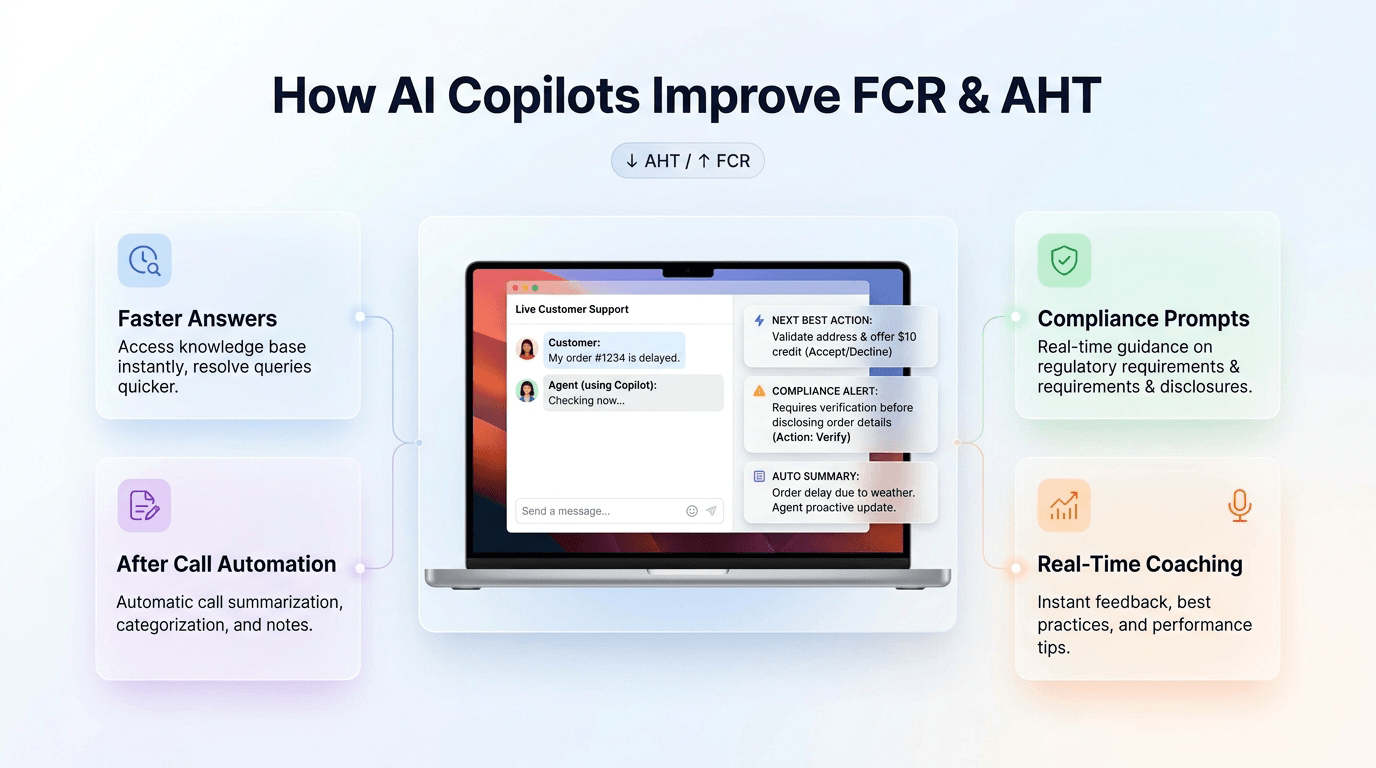
When an agent spends 45% of calls searching for answers, every second of that search adds to handle time and reduces the odds of resolving the issue on the first call. AI agent assist eliminates the search. It listens to the conversation, identifies the customer’s intent, and pushes the relevant knowledge base article, script, or process step to the agent’s screen in real time.
No tabbing. No hold time. No dead air.
Compliance Prompts Before the Violation
In regulated industries, agents must say specific disclosures, avoid certain phrases, and follow strict scripts. Real-time coaching tools monitor the conversation and flag when a required disclosure is about to be missed, not after the call is done. This prevents compliance violations before they happen, which is infinitely cheaper than catching them in a post-call QA review.
Balto, one of the early real-time guidance vendors, reports a 40% decrease in compliance violations for a customer over a six-month period after deployment.
After Call Work Automation
More than half of calls require agents to write notes, update the CRM, and summarize the interaction. AI copilots now handle this automatically. The call ends, the summary appears, the CRM updates, and the agent moves to the next call. This shaves minutes off every interaction, which at scale compounds into thousands of recovered agent hours per month.
Real-Time Coaching on Soft Skills
Beyond knowledge retrieval, some platforms coach agents on tone, empathy, and talk ratio during the call. If an agent is talking too fast, the copilot nudges. If sentiment drops, it alerts. If an objection comes up, it suggests a rebuttal. This is essentially what a floor supervisor does, except the AI does it on 100% of calls instead of the handful a supervisor can physically monitor.
For more on how to structure coaching sessions around these insights, we have a separate guide.
Real Time Agent Assist vs Post Call Analytics: What’s the Difference?
Most conversation intelligence and Auto QA platforms analyze calls after they end. They score transcripts, surface coaching moments, and flag compliance issues retrospectively. That’s valuable, but it can’t change what already happened on the call.
Real-time agent assist operates during the call. It changes outcomes while the customer is still on the line. That’s the fundamental difference.
The smartest contact centers use both. Real-time agent assist to improve the live interaction. Post call analytics and conversation intelligence to identify patterns, measure quality, and drive ongoing training. They’re layers of the same stack, not competitors.
If you’re building that full stack, understanding how AI agents work in call centers gives you the complete picture.
Who Offers Real-Time Agent Assist in 2026?
Here’s a quick snapshot of the major players, based on vendor documentation and public product pages.
- Verint offers Real Time Agent Assist and a Coaching Bot that provides next best action suggestions during live calls. Their CX/EX Scoring Bot delivers real-time sentiment scores for both customer experience and employee experience on every call.
- NICE launched Enlighten Copilot, which provides contextual suggestions, automated summaries, and workflow support across voice and digital channels.
- Five9 ships Agent Assist as part of its Genius AI suite, offering real-time transcription, guidance prompts, and automatic call summaries.
- Talkdesk offers Copilot, which listens to both sides of the conversation and delivers context-aware replies, knowledge base answers, and automated notes.
- Balto pioneered real-time on-screen guidance. It has guided over 250 million calls and was named a Pioneer in the CMP Research 2025 Prism for Automated QA and QM.
- Cresta combines real-time coaching with conversation intelligence and agent assist in one platform, serving large enterprise operations.
- Salesforce built Agent Assist into Agentforce Contact Center, launched in March 2026, unifying voice, digital channels, CRM data, and AI natively.
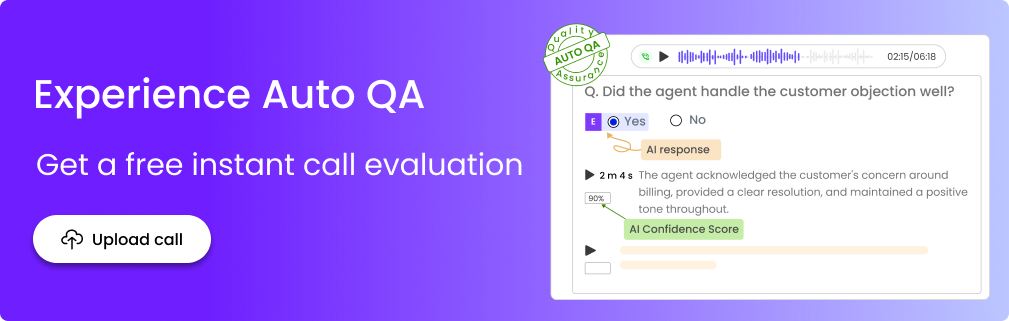
- Enthu.AI offers live agent assist with real-time alerts when sentiment dips, silence stretches, or conversations go off track. It pairs this with Auto QA, custom scorecards, and coaching workflows, giving contact centers both the during-call support and the after-call intelligence in a single platform. For more on how call center automation connects all these pieces, we cover that separately.
What to Look for When Evaluating Agent Assist Software?
Not all agent assist tools are equal. Here’s what to evaluate.
- Latency. If the suggestion arrives five seconds after the customer asked the question, it’s useless. Look for sub second response times on knowledge retrieval.
- Knowledge base integration. The copilot is only as smart as the content it can access. Make sure it connects to your actual knowledge base, CRM, and process documentation, not just a generic FAQ.
- Compliance capabilities. For regulated industries, real time coaching on disclosures and script adherence is essential. General purpose copilots often lack this.
- Agent experience. If the copilot creates more noise than signal, agents will ignore it. The best tools are configurable so supervisors can dial guidance up or down based on agent tenure.
- Post call connection. The most valuable platforms connect real-time assist data to call center training workflows. The coaching insight from a live call should feed directly into the agent’s development plan, not disappear when the call ends.
FAQs
1. What is real-time agent assist in a contact center?
Real-time agent assist is AI software that listens to live customer calls and provides agents with answers, compliance prompts, and coaching cues during the conversation. It works alongside the agent in real time, not after the call ends.
2. How does AI agent assist improve first call resolution?
By surfacing relevant answers from the knowledge base the moment a question is asked, agents can resolve issues without putting customers on hold or escalating to a supervisor. Faster access to the right information means more issues resolved on the first call.
3. What is the difference between an AI copilot and a chatbot?
A chatbot handles customer conversations directly. An AI copilot assists the human agent during a customer conversation. The copilot does not talk to the customer. It helps the agent talk to the customer better.
4. Does a real-time agent assist reduce average handle time?
Yes. By eliminating manual answer searching, automating after-call work, and preventing hold time, AI copilots directly reduce the minutes agents spend on each interaction. The Verint 2026 report found that 45% of calls involve mid-call answer searching, which is exactly the time real-time assist eliminates.
Bottom Line
Real-time agent assist is the second biggest AI trend in contact centers after voice AI agents. And unlike voice agents, which replace certain call types entirely, agent assist makes your existing human agents better at the calls that still need a human touch.
The data is clear. Agents spend nearly half their calls hunting for answers. A third are ready to quit. AI copilots fix the first problem and help with the second.
If you’re evaluating platforms, start with the question that matters most: does this tool make my agents’ lives easier on a live call? If the answer is yes, AHT goes down, FCR goes up, and your best agents stick around longer.

 On this page