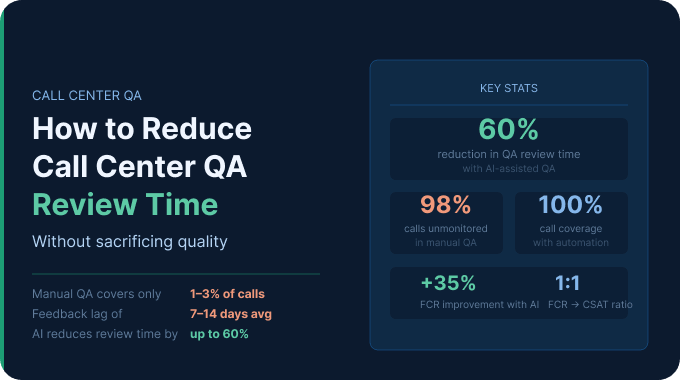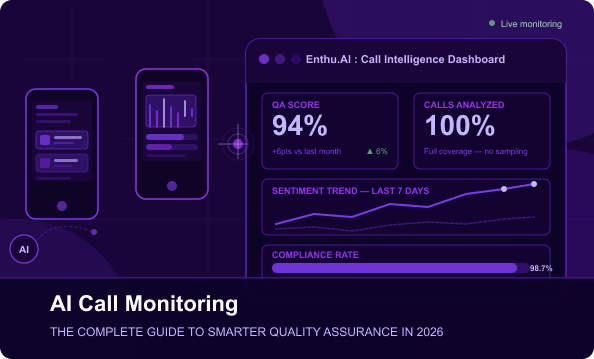
Every day, millions of customer calls end with no one reviewing them. In the traditional contact center, quality assurance teams sample 2–5% of calls meaning 95–98% of conversations go completely unanalyzed. Compliance violations slip through. Coaching opportunities are missed. Customer frustration goes undetected until it shows up in a churn report.
AI call monitoring changes this equation entirely. By applying speech recognition, natural language processing (NLP), and machine learning to every single call in real time or after the fact AI systems can score, flag, and learn from 100% of interactions at a fraction of the cost of manual review.
This guide covers everything: how to automate call quality monitoring, its measurable business benefits, compliance handling, the best platforms in 2026, and a step-by-step implementation playbook. Whether you’re just starting to explore the space or ready to compare vendors, you’ll find what you need here.
95–98% of calls go unreviewed with manual QA
100% call coverage is achievable with AI
90% reduction in compliance review time (Enthu.AI customers)
300–400% reported ROI within 12 months
1. What Is AI Call Monitoring?
AI call monitoring is the use of artificial intelligence, primarily automatic speech recognition (ASR), natural language processing (NLP), and machine learning, to automatically transcribe, analyze, and score phone conversations. Unlike traditional call quality monitoring, which relies on manual review of a small sample, AI monitoring extracts actionable insights from every single call with no human in the loop.
It is not a new concept call recording has existed for decades. What is new is scale, speed, and intelligence. Modern AI monitoring platforms can process thousands of calls per hour, flag issues in real time, and surface patterns that no human QA team could ever spot in a 2% sample.
Quick definition
AI call monitoring is an automated system that uses speech-to-text, NLP, and machine learning to analyze 100% of customer calls generating quality scores, compliance alerts, sentiment signals, and agent coaching insights without manual review.
How it differs from traditional call recording
The gap is not just technological, it is strategic. Traditional recording captures audio. AI monitoring understands it. For a deeper look at what that means operationally, see our guide on call center quality assurance. Here is the practical difference at a glance:
| Traditional Call Recording | AI Call Monitoring |
| 2–5% of calls reviewed | 100% of calls analyzed automatically |
| Manual, time-consuming QA scoring | Automated scoring in seconds |
| Reactive: found after the fact | Proactive: real-time alerts possible |
| High labor cost, hard to scale | Scales without adding headcount |
| Subjective, inconsistent human scoring | Objective, consistent AI scoring |
The four core components
- 1. Speech-to-text (ASR): Converts spoken audio into searchable, analyzable text. See how Enthu.AI’s AI transcription software achieves 99%+ accuracy even for non-native accents.
- 2. Natural language processing (NLP): Understands intent, context, topics, keywords, and named entities, powering Enthu.AI’s speech analytics engine.
- 3. Sentiment and emotion analysis: Detects frustration, satisfaction, or aggression in both voices. Learn more in our guide to sentiment analysis and how it improves CX.
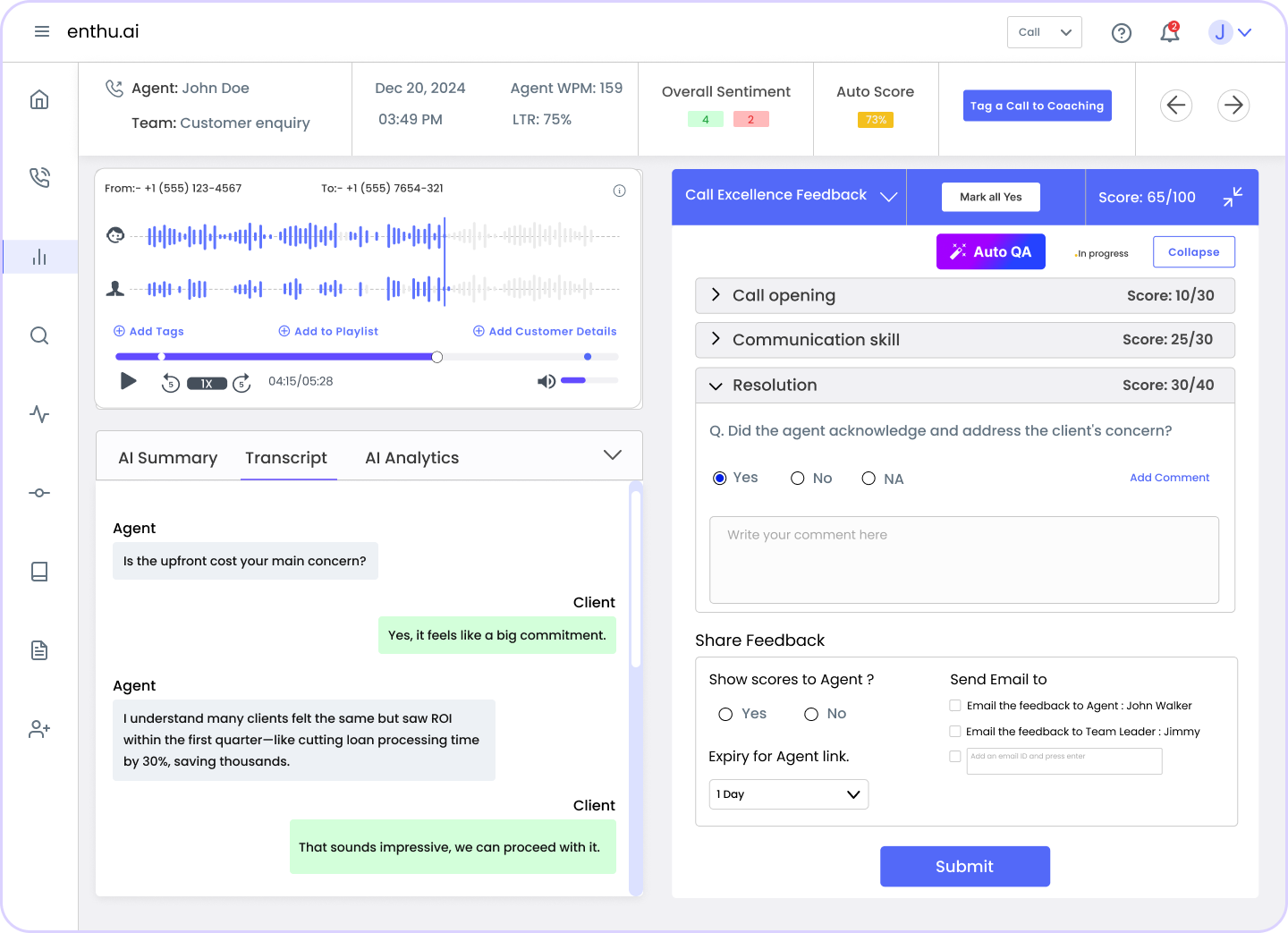
- 4. Automated QA scoring: Evaluates each call against your configurable scorecard, powered by Enthu.AI’s Auto QA with GenAI feature.
Who uses AI call monitoring?
- Contact centers seeking 100% QA coverage without growing their QA team
- Sales organizations using conversation intelligence to coach reps and forecast pipeline
- Financial services and insurance firms managing regulatory compliance (TCPA, MiFID II, FCA)
- Healthcare providers ensuring HIPAA-compliant agent conversations
- Debt collection agencies are monitoring for FDCPA violations
- BPOs and outsourcers needing fast, scalable quality monitoring across multiple clients
2. How Does AI Call Monitoring Work? (Step-by-Step)
Here is the end-to-end pipeline, from the moment a call starts to the moment a QA score lands in a supervisor’s dashboard:
Step 1: Call capture and ingestion
The process begins when a call is initiated through your telephony system, VoIP, UCaaS, CCaaS platform, or on-premise PBX. Most AI monitoring platforms integrate via API or SIP trunk to intercept the audio stream. Enthu.AI, for example, connects in days (not months) with most major phone systems and CRMs. In real-time mode, audio is streamed live. In post-call mode, the recorded file is queued for batch processing.
Step 2: Speech-to-text transcription
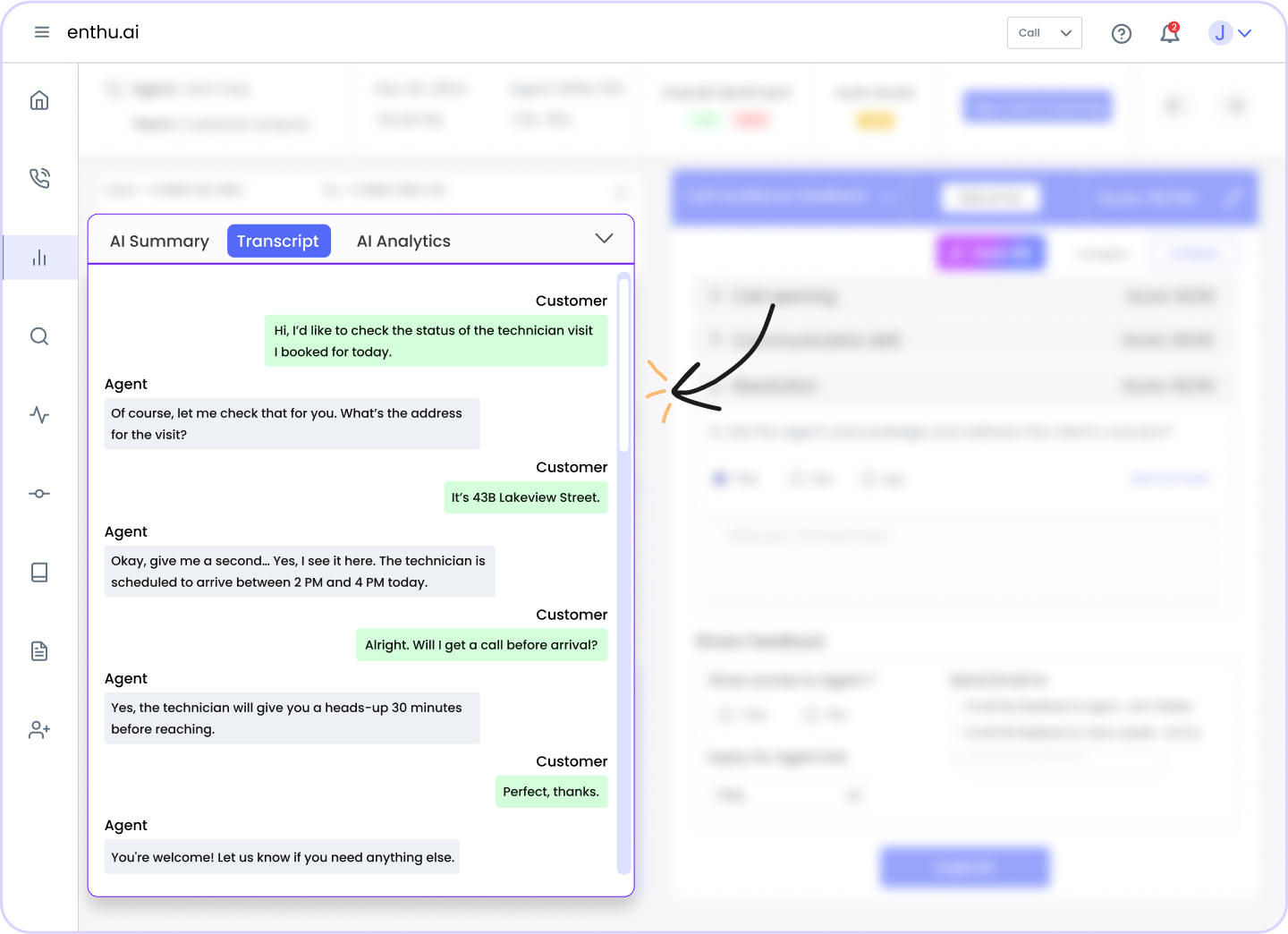
The audio stream is passed to an ASR engine, which converts speech into a time-stamped, speaker-separated transcript. Enthu.AI’s AI transcription software achieves 99%+ accuracy even for calls with strong accents or background noise, a common differentiator for contact centers with globally distributed teams.
Step 3: NLP and intent analysis
Once the transcript is generated, the NLP layer processes it for meaning: topic detection, intent recognition, keyword and phrase spotting (compliance terms, competitor mentions, escalation signals), and named entity recognition. This is the foundation of Enthu.AI’s call center speech analytics capability.
Step 4: Sentiment and emotion detection
AI models analyze both linguistic content and acoustic characteristics to determine sentiment. Learn how Enthu.AI uses this to surface coaching moments and compliance risks in our detailed sentiment analysis guide and our piece on using sentiment analysis to improve customer experience.
Step 5: Automated scoring and reporting
The system scores the call against your configured QA scorecard, checking for required disclosures, tone, script adherence, and issue resolution. With Enthu.AI’s Auto QA, the entire pipeline runs automatically. Supervisors open the dashboard and find every call already scored, ranked by priority, and linked to specific coaching moments. To understand what good scorecards look like, see our guide to call center evaluation forms and agent scorecards.
Related blog: Auto QA Software: 2026 Buyer’s Guide.
Enthu.AI insight
The typical Enthu.AI customer goes from setup to first scored calls in less than 48 hours. The platform is designed for QA managers and operations leads not data engineers. No months-long configuration process required.
See Enthu.AI in action free for 14 days
Want to watch AI score your own calls? Start a free trial no credit card, no setup fees, no sales call required. enthu.ai/pricing
3. Key Benefits of AI Call Monitoring
1. 100% call coverage solving the 2–5% sampling problem
This is the foundational benefit. A compliance violation that occurs in 3% of calls will almost certainly never surface in a 2% random sample. AI monitoring eliminates this blind spot. Our guide on call center automated QA explains exactly how this shift from sampling to full coverage works in practice.
2. Faster agent coaching and development
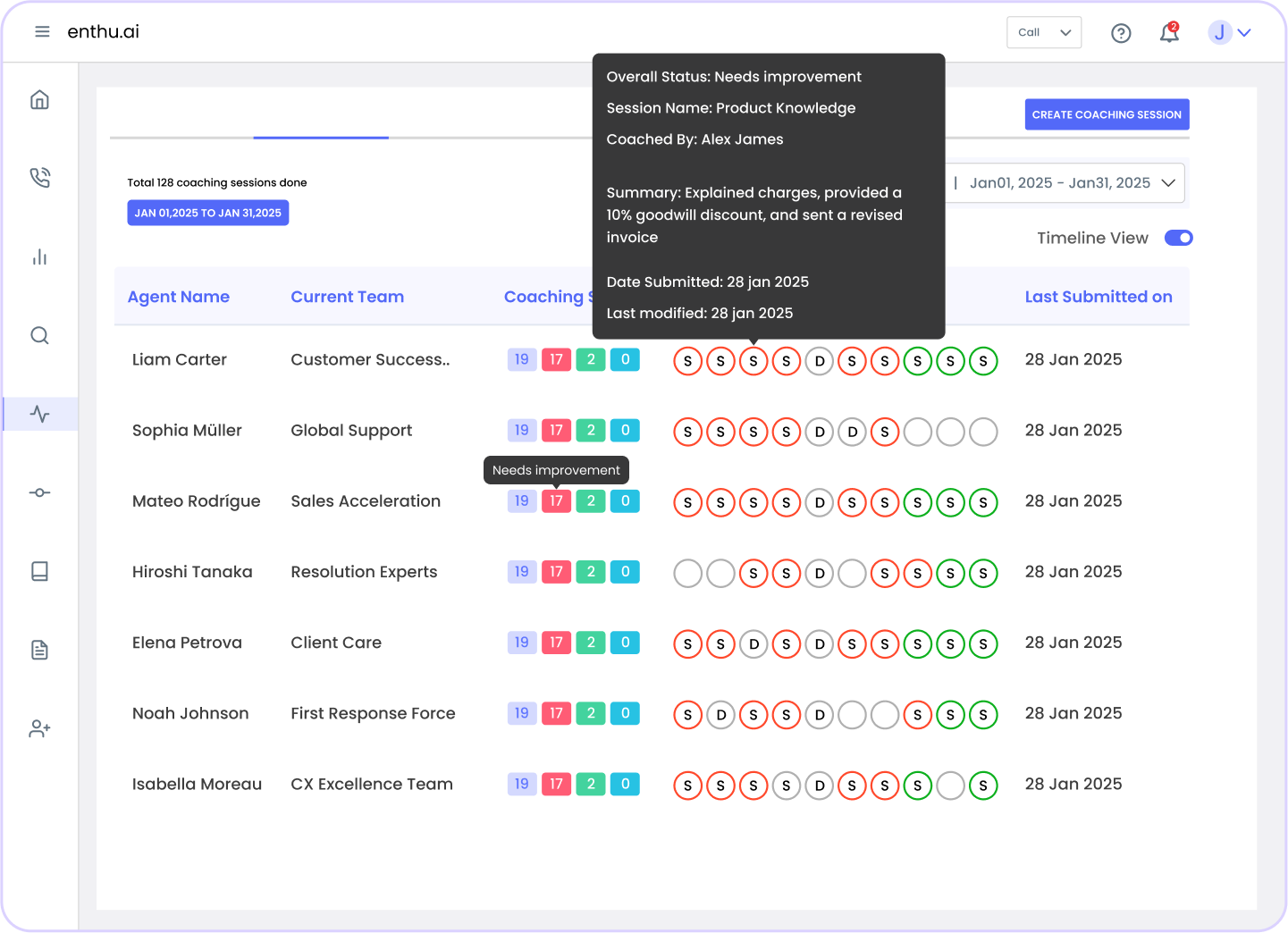
AI monitoring can trigger automated feedback within minutes of a call ending. Enthu.AI’s agent coaching software surfaces the exact moments in a call where improvement is needed, so coaches spend time coaching, not digging through recordings. For a comparison of the best tools for this, see our roundup of agent performance and coaching tools.
3. Measurable improvement in customer satisfaction
By systematically identifying calls with negative sentiment outcomes and correlating them with specific agent behaviors, AI monitoring creates a feedback loop that continuously improves CX. Enthu.AI customer CallHippo reduced revenue churn by 20% and increased CSAT by 21% after deploying automated QA monitoring.
4. Reduced average handle time (AHT)
AI surfaces patterns in long or inefficient calls, repeated transfers, unnecessary holds, unclear resolution paths and feeds those insights into coaching. The operational math is compelling: a contact center handling 10,000 calls per day that reduces AHT by just 30 seconds saves approximately 83 agent-hours daily.
5. Significant ROI and labor cost reduction
The ROI case is well documented. Enthu.AI customers report compliance review time down by 90% and QA process efficiency improvements that allow the same team to cover dramatically more call volume. Reported ROI figures across the industry range from 300–400% over 12 months when factoring in reduced QA headcount, lower churn from improved CX, and compliance cost avoidance.
6. Fairer, more objective performance evaluations
A persistent agent complaint is that QA scoring feels arbitrary, one supervisor scores differently than another, and a 2% sample is not representative. AI scoring is consistent, objective, and covers every call. This improves agent trust in the feedback process and significantly reduces performance review disputes.
4. Real-Time vs. Post-Call AI Monitoring: What’s the Difference?
The distinction between real-time and post-call AI monitoring is one of the most important decisions teams face when evaluating platforms. They serve different purposes and involve different tradeoffs.
1. Real-time monitoring explained
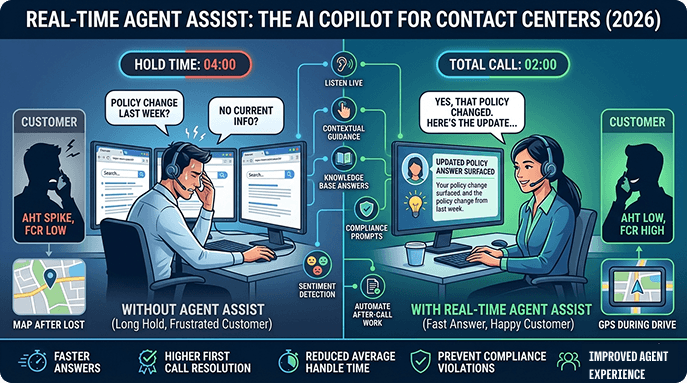
Real-time monitoring analyzes the call as it happens, typically with a latency of 1–3 seconds. This enables live agent assist (pop-up suggestions during the call), immediate compliance alerts (e.g., flagging a TCPA violation before it escalates), supervisor whisper coaching, and instant escalation triggers when a customer’s sentiment drops sharply.
Real-time monitoring is the right choice for high-stakes, regulated, or complex sales environments where the cost of a single failure is high. Its infrastructure requirements are more demanding, streaming audio processing is computationally intensive which is reflected in higher pricing.
2. Post-call monitoring explained
Post-call monitoring processes the recording or transcript after the conversation ends. It is better suited to bulk quality assurance, trend analysis across thousands of calls, systematic coaching programs, and compliance auditing, where same-day review is sufficient. Post-call processing is significantly cheaper to run at scale because it uses batch rather than streaming infrastructure. Enthu.AI’s core platform operates in this mode, making it highly accessible for teams that want 100% QA coverage without enterprise-tier streaming infrastructure costs.
| Feature | Real-Time Monitoring | Post-Call Monitoring |
| Analysis timing | During the call (live) | After the call ends |
| Latency | Milliseconds | Minutes to hours |
| Primary use case | Agent assist, compliance alerts | QA scoring, trend analysis |
| Best for | High-stakes calls, regulated industries | Bulk coaching, performance review |
| Cost level | Higher (streaming infra) | Lower (batch processing) |
| Actionability | Immediate intervention possible | Retroactive insight only |
Which should you use?
The answer is often both. Mature deployments use real-time monitoring for high-risk call types (compliance-heavy conversations, high-value sales calls, angry customer escalations) and post-call monitoring for the bulk of their quality assurance and coaching workflows. If you are just getting started, begin with post-call the ROI is faster and implementation is simpler.
5. AI Call Monitoring for Compliance and Risk Management
For organizations in regulated industries, AI call monitoring is not a nice-to-have it is rapidly becoming a compliance necessity. The 97% of calls that go unreviewed in a manual QA model represent a massive, unquantified liability. A single TCPA violation can carry civil penalties of $500–$1,500 per call. A pattern of FDCPA violations can trigger class-action litigation. In this context, the cost of AI monitoring looks very different from a line item.
Regulatory reality check
TCPA violations: up to $1,500 per call. FDCPA class actions: up to $500,000 or 1% of net worth. FCA Consumer Duty violations in the UK: unlimited fines. One systematic compliance failure that AI could have caught and didn’t, because you were only reviewing 3% of calls, can wipe out years of operational savings.
Key regulations AI call monitoring addresses
- TCPA (Telephone Consumer Protection Act): Monitors for consent disclosures, calling time restrictions, Do Not Call compliance, and automated dialing disclosures.
- FDCPA (Fair Debt Collection Practices Act): Flags prohibited language, harassment indicators, and overshadowing disclosures in debt collection calls.
- HIPAA: Detects unauthorized disclosure of protected health information (PHI) in healthcare call environments.
- MiFID II / FCA: Ensures required disclosures are made on financial product calls; maintains complete audit trails for regulatory examination.
- PCI DSS: Detects when agents request or repeat card numbers in non-compliant ways.
- FCA Consumer Duty (UK): Identifies vulnerable customer signals, confusion, emotional distress, and financial stress for enhanced support routing.
Real-time compliance alerts in practice
When a prohibited phrase is detected, for example, an agent making an earnings guarantee on a financial product call, the AI triggers an immediate alert. Depending on configuration, this can fire a screen pop to the agent, page a supervisor, or flag the call for mandatory post-call review. The goal is intervention before the call ends, not after the complaint is filed.
Audit trails and regulatory reporting
Every analyzed call generates a structured audit record: timestamp, transcript, sentiment scores, compliance checklist results, and agent response data. Most enterprise-grade platforms store these records in compliance-grade encrypted storage and can export structured reports for regulatory examination. Enthu.AI is built with enterprise-grade data privacy standards and undergoes regular third-party security audits so the audit trail itself is audit-ready.
6. AI Call Monitoring for Sales Teams
When AI call monitoring is applied to outbound and inbound sales conversations, it takes on a distinct identity: conversation intelligence. While QA-focused monitoring is about catching what went wrong, sales-focused monitoring is about replicating what went right.
Conversation intelligence vs. quality assurance
Conversation intelligence platforms analyze sales calls to identify the behaviors of top performers: how they handle objections, how much they talk vs. listen, which topics correlate with closed deals, and which phrases predict deal risk. The output is not a compliance scorecard it is a blueprint for coaching every rep to perform like your top 10%. Enthu.AI serves both use cases QA teams use it to maintain quality standards, while sales managers use it to surface coachable moments and track rep improvement over time.
Real-time coaching during live sales calls
During a live call, AI can surface battle cards when a competitor is mentioned, prompt the rep with pricing guidance when discount conversations start, and flag when the rep has been talking for too long without asking a question. This real-time guidance is particularly valuable for new reps who have not yet internalized the full playbook.
Pipeline visibility and deal risk signals
By analyzing call content across an entire pipeline, AI monitoring can flag deals where sentiment has been consistently negative, key stakeholders have gone quiet, or budget and authority have not been confirmed. This transforms monitoring from a coaching tool into a pipeline management tool one that gives sales managers earlier warning on deals at risk.
AI scorecards for sales reps
Automated scoring assesses whether the call agenda was set, pain points confirmed, and a clear next step agreed before the call ended. Enthu.AI’s no-code scorecard builder lets your sales ops team own this configuration end-to-end. For guidance on what to include, see our guide to call center evaluation forms and agent scorecards.
7. Top AI Call Monitoring Software in 2026
The AI call monitoring market has matured significantly. Below is a current overview of leading platforms, organized by primary use case, followed by a full feature comparison table.
What to look for in an AI call monitoring platform
- Coverage model: Do you need real-time, post-call, or both?
- Compliance requirements: Which specific regulations do you need to monitor?
- Integration ecosystem: Does it connect to your CRM, telephony platform, and coaching tools?
- Transcription quality: What is the ASR accuracy for your specific languages and accents?
- Configurability: Can your QA team build scorecards and rules without engineering support?
- Time to value: Can you get from signup to first scored calls in days not months?
| Platform | Best For | Real-Time | Post-Call | Compliance | Price |
| Enthu.AI | QA, Coaching & Compliance | Yes | Yes | HIPAA, SOC2, GDPR | $$ |
| Observe.AI | Enterprise contact centers | Yes | Yes | HIPAA, SOC2 | $$$ |
| Gong | B2B sales teams | Yes | Yes | SOC2 | $$$ |
| Dialpad | SMB / Sales | Yes | Yes | GDPR, HIPAA | $$ |
| NICE CXone | Large enterprise | Yes | Yes | PCI, HIPAA | $$$$ |
| Talkdesk | Mid-market | Yes | Yes | SOC2, GDPR | $$$ |
| Aircall | SMB | No | Yes | GDPR | $ |
| Balto | Compliance-heavy outbound | Yes | Limited | TCPA, FDCPA | $$ |
Platform spotlights
Enthu.AI is purpose-built for contact center QA, agent coaching, and compliance monitoring. It stands out for its 99%+ transcription accuracy, fast setup (most customers are live within 48 hours), and highly competitive pricing, making enterprise-grade AI monitoring accessible to teams that previously assumed it was out of budget. Customers consistently highlight the platform’s ease of use, responsive support team, and ability to auto-surface the calls that actually need attention rather than requiring manual digging. Best for: SMBs, BPOs, and mid-market contact centers wanting powerful QA without the enterprise price tag.
Observe.AI is the enterprise standard for large contact center QA. Strong on analytics depth and workforce management integration. Best for: large contact centers (200+ seats) with complex QA programs and dedicated technical teams.
Gong leads the sales conversation intelligence category. Its strength is deal intelligence correlating call behavior to pipeline outcomes. Not a compliance tool. Best for: B2B sales teams focused on rep performance and deal visibility.
Dialpad offers an integrated communications platform with built-in AI monitoring at competitive SMB price points. Best for: smaller teams wanting a single vendor for calls and AI.
Balto is purpose-built for real-time compliance in regulated industries, particularly collections and financial services. Best for: FDCPA/TCPA-regulated outbound teams.
8. How to Implement AI Call Monitoring: A Step-by-Step Playbook
The most common implementation failure is over-engineering the launch. Teams spend months designing the perfect scorecard and never go live. The playbook below is designed for a 90-day first deployment cycle start small, prove value, and expand.
Phase 1 (Days 1-14): Define use cases and audit your call environment
Map your call types by volume and risk. Identify 1–2 high-priority use cases (e.g., compliance monitoring OR agent coaching not both simultaneously on day one). Audit your telephony stack to confirm compatibility with your shortlisted platform. Enthu.AI’s team handles this assessment for free as part of onboarding.
Phase 2 (Days 15-21): Choose between a SaaS platform and a custom build
For 95% of organizations, a SaaS platform is the right choice. Custom builds are only cost-effective at extreme scale (10M+ calls/year) or when compliance requires on-premise processing. Evaluate 2–3 platforms against your use case criteria. Enthu.AI offers 5 free call evaluations so you can test accuracy on your actual calls before committing.
Phase 3 (Days 22-45): Configure scorecards, compliance rules, and alerts
Translate your manual QA scoring rubric into AI-readable scorecard criteria. Start with 8–12 items. Configure compliance phrase libraries. Set alert thresholds conservatively; too many false positives will lose agent trust immediately. Enthu.AI’s no-code scorecard builder means your QA manager can own this without IT involvement.
Phase 4 (Days 46–60): Train agents and communicate the program
Agents who understand why they are being monitored, what will be scored, and how feedback will be used perform significantly better than those who feel surveilled without context. Be transparent, involve team leads, and emphasize development over discipline. The shift to objective AI scoring consistent for every agent, every call tends to build more trust than manual QA once agents experience it.
Phase 5 (Days 61–90+) Measure, iterate, and expand
Track your baseline KPIs from week one. At 30 days, review false positive rates and scorecard accuracy. At 60 days, assess whether coaching feedback is driving QA score improvement. At 90 days, present the business case for expanding to additional call types or teams. Most Enthu.AI customers expand to additional use cases within 90 days of their initial deployment.
9. KPIs and Metrics to Track with AI Call Monitoring
AI call monitoring generates a large volume of data. Without the right measurement framework, teams drown in metrics without acting on any of them. Here is a structured starting point organized by outcome category.
| KPI | What It Measures | Benchmark / Target |
| QA Score | Average AI-assessed quality score per agent or team | Target: 80%+ |
| First-Call Resolution | % of issues resolved without a callback | Industry avg: 70–75% |
| Average Handle Time | Mean call duration including wrap-up | Baseline varies by industry |
| CSAT / NPS | Customer satisfaction linked to sentiment analysis | Track vs. QA score correlation |
| Compliance Rate | % of calls meeting all required disclosures | Target: 99%+ |
| Escalation Rate | % of calls escalated to supervisor | Lower is better post-coaching |
| Sentiment Trend | Week-over-week shift in positive/negative sentiment | Leading indicator of churn |
| Violation Rate | % of calls flagged for compliance breach | Target: <1% |
Measurement tip
Prioritize leading indicators over lagging ones. Sentiment trend and violation rate will tell you something is going wrong weeks before it shows up in CSAT scores or a compliance report. Build your monitoring dashboard to surface these signals first and set up weekly digest emails so your managers see them automatically.
10. Common Challenges and How to Overcome Them
Challenge 1: Agent resistance and privacy concerns
Challenge: Agents may feel surveilled or anxious about being scored on every call.
Solution: Frame monitoring as a development tool, not a surveillance system. Emphasize that 100% coverage means agents are no longer judged on unrepresentative samples. Many Enthu.AI customers report that agents actually prefer objective AI scoring over inconsistent human QA review because it feels fairer.
Challenge 2: Transcription accuracy for accents and jargon
Challenge: ASR accuracy drops for non-native accents, regional dialects, and industry-specific vocabulary.
Solution: Choose platforms that demonstrate high accuracy on your specific call data before you commit. Enthu.AI’s ASR is rated 99%+ by customers specifically for its performance on calls with strong non-native accents a differentiator for teams with globally distributed agents or customer bases.
Challenge 3: Integration with legacy telephony systems
Challenge: Legacy PBX or on-premise telephony systems often lack modern API support for audio streaming.
Solution: Most platforms support multiple ingestion methods, direct API, SIP trunk recording, or post-call file upload. Enthu.AI will build custom integrations for telephony platforms not already in their supported list, at no extra charge, as part of the onboarding process.
Challenge 4: False positives in compliance flagging
Challenge: An overly sensitive rule library flags dozens of calls per day, overwhelming supervisors and causing alert fatigue.
Solution: Start with a small, high-confidence rule set. Use phrase proximity rules (e.g., flag ‘guarantee’ only if it appears within 10 words of a financial product name). Review false positives weekly for the first 60 days and iterate thresholds. Target a false positive rate below 5% on compliance alerts.
Challenge 5: Analysis paralysis
Challenge: AI monitoring generates enormous amounts of insight data, and teams without a clear workflow simply stop looking at dashboards after a few weeks.
Solution: Assign dashboard ownership to specific roles. QA managers own QA scores. Compliance officers’ own violation rates. Sales managers’ own conversation trends. Enthu.AI’s role-based dashboards make this straightforward; each team sees what is relevant to them without the noise.
11. AI Call Monitoring Best Practices
Organizations that get the most from AI call monitoring share a common set of operational disciplines. These best practices are distilled from successful deployments across contact centers, sales organizations, and regulated industries.
- Use explainable, configurable AI not black-box scoring. If you cannot understand why a call received a specific score, neither can your agents. Choose platforms where every scorecard criterion is transparent and auditable.
- Align AI criteria to actual business outcomes. Score what matters to customers and the business not just what is easy to detect. ‘Customer confirmed their issue was resolved’ is more valuable than ‘agent said the script word-for-word.’
- Combine automated scoring with targeted human review. AI handles the volume; humans review the edge cases, the highest-stakes calls, and the calls that generate disputes. A hybrid model where AI scores 100% and humans review 5–10% of flagged calls is the industry standard.
- Be transparent with agents. Disclose what is monitored, what the scoring criteria are, and how scores will be used. In many jurisdictions, call recording disclosure is a legal requirement not optional.
- Retrain AI models as your business evolves. Scripts change, products change, regulations change. An AI model trained on last year’s call data will degrade in accuracy over time. Schedule quarterly model review cycles.
- Start narrow and prove value fast. Pick one high-volume call type, deploy, measure ROI at 90 days, then expand. Enthu.AI customers consistently report faster time-to-value when they start with a focused use case rather than trying to monitor everything on day one.
Ready to monitor 100% of your calls starting today?
Join 500+ contact centers, sales teams, and BPOs already using Enthu.AI to transform call quality. 14-day free trial. No credit card. Live in 48 hours. enthu.ai/pricing
FAQS
1. Is AI call monitoring legal?
In most jurisdictions, yes with disclosure requirements. In the United States, federal law requires at least one-party consent for call recording, but many states (California, Florida, Illinois) require all-party consent. Most AI monitoring platforms, including Enthu.AI, include built-in recording disclosure support. For cross-border operations, GDPR (EU) and PIPL (China) impose additional data processing requirements. Always consult legal counsel for your specific regulatory environment.
2. Does AI call monitoring replace human QA analysts?
It fundamentally changes their role rather than eliminating it. AI handles the volume and consistency of call scoring. Human analysts shift to exception management (reviewing edge cases and appeals), scorecard design and iteration, interpreting trend data, and coaching delivery. Enthu.AI customers consistently report that their QA teams do ‘more and better monitoring in the same amount of time’ not that headcount is cut.
2. How accurate is AI speech-to-text transcription for call centers?
Leading ASR engines now achieve 90–95%+ accuracy for standard English in clear audio. Enthu.AI reports 99%+ transcription accuracy based on customer feedback, with particular strength on calls involving non-native accents a common challenge for contact centers with globally distributed teams. Domain-specific vocabulary training can recover additional accuracy for highly technical industries.
4. How much does AI call monitoring software cost?
Pricing varies widely by platform and scale. SMB tools start at around $30–$100 per user per month with basic AI features. Mid-market platforms like Dialpad typically run $75–$150 per user per month. Enterprise solutions can exceed $300 per user per month. Enthu.AI offers custom pricing tuned to team size and needs, with a 14-day fully functional free trial no credit card required so you can test on your own calls before committing to any spend.
5. What is the difference between call monitoring and conversation intelligence?
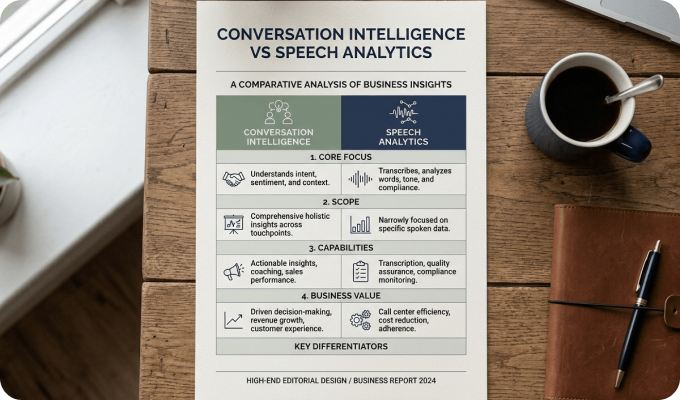
Call monitoring is the broader category any system that analyzes calls for quality, compliance, or operational insight. Conversation intelligence is a specific sales-focused application that identifies winning behaviors, deal risk signals, and coaching opportunities to improve revenue outcomes. Enthu.AI serves both use cases: QA teams use it for compliance and quality monitoring, while sales managers use it to surface coaching moments and track rep performance over time.
6. Can AI call monitoring work for small businesses?
Yes, and the market for SMB-accessible tools has expanded considerably. Enthu.AI is specifically recommended for small teams wanting robust auto-QA without the budget or complexity of larger enterprise suites. The platform is designed to get teams up and running in days, not months, and offers flexible pricing that scales with your team size.

 On this page