If you’ve spent any time shopping for call QA software, you’ve probably noticed that vendors throw around “conversation intelligence” and “speech analytics” like they mean the same thing. They don’t. And picking the wrong category can leave you paying for capabilities you don’t need, or worse, missing the ones you do.
This guide breaks down the actual difference between conversation intelligence and speech analytics, explains where they overlap, where they don’t, and helps you figure out which one fits your contact center in 2026.
Speech Analytics: What It Actually Is
Speech analytics is the older of the two categories. It was built for a world where customer service happened almost entirely on the phone.
Speech analytics software takes voice recordings, transcribes them into text, and then scans that text for predefined keywords, phrases, and patterns. When a customer says “cancel my account” or an agent skips a required compliance disclosure, speech analytics flags it.
But it goes beyond words. Good speech analytics tools also analyze acoustic properties: tone, pitch, volume, talk speed, silence duration, and stress markers. A customer can say “I understand” in a calm tone and mean it, or say it through gritted teeth and mean the opposite. Speech analytics detects the difference because it’s analyzing how things are said, not just what.
The core capabilities include call transcription, keyword and phrase spotting, acoustic sentiment analysis, silence and dead air detection, and compliance monitoring. If your operation is primarily phone calls and you need to flag specific phrases or detect emotional states, speech analytics does that job well.
For a deeper look at the specific tools in this category, our speech analytics software comparison covers the top platforms.
Conversation Intelligence: What It Actually Is
Conversation intelligence is the broader, more recent category. It does everything speech analytics does, and then extends the analysis across every channel: voice, chat, email, SMS, and social messaging.
Where speech analytics asks “what did they say and how did they say it?”, conversation intelligence asks “what did they mean, what happened because of it, and what should we do about it?”
Conversation intelligence platforms analyze content and topics (issue categories, product mentions, competitor references), intent and context (customer goals, topic shifts, resolution paths), agent performance (scorecard adherence, coaching opportunities, skill gaps), and business outcomes (whether the call led to a resolution, churn, upsell, or escalation).
The key differentiator is the action layer. Conversation intelligence doesn’t just report insights. It feeds those insights into coaching workflows, automated QA scorecards, and performance management systems. Speech analytics tells you a problem exists. Conversation intelligence tells you why it exists, who needs coaching, and what to do about it.
The conversation intelligence software market was valued at $22.89 billion in 2024 and is projected to reach $49.52 billion by 2032, growing at a 10.18% CAGR, according to SNS Insider research. That growth reflects the shift from voice-only analysis to full omnichannel conversation analysis.

Related blog: 11 Best conversation intelligence software in 2026.
The Core Differences at a Glance
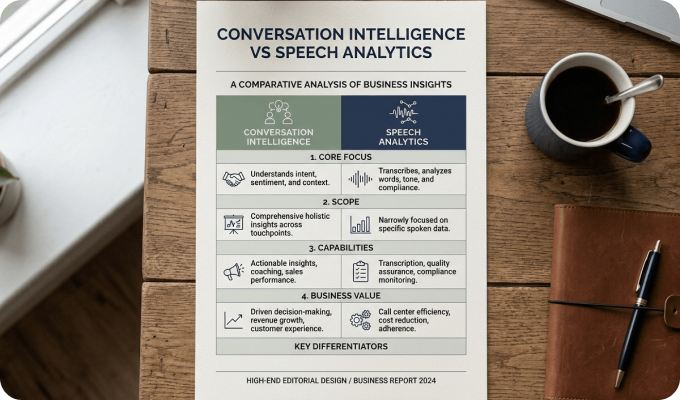
1. Channel coverage. Speech analytics covers voice calls only. Conversation intelligence covers voice, chat, email, SMS, and social. If your customers only call you, speech analytics might be enough. If they also message you on WhatsApp, email your support team, and chat on your website, you need the omnichannel view.
2. Analysis depth. Speech analytics identifies keywords and acoustic signals. Conversation intelligence understands context, intent, topic progression, and resolution outcomes. One tells you the agent said “I understand your frustration.” The other evaluates whether the customer’s sentiment actually improved after the agent said it.
3. Output and action. Speech analytics generates reports and flags. Conversation intelligence feeds findings directly into Auto QA, agent scorecards, coaching sessions, and performance dashboards. The insight to action gap is where most speech analytics deployments stall.
4. Pricing. According to published market data, speech analytics software typically costs $15 to $50 per agent per month. Conversation intelligence platforms range from $50 to $150 plus per agent per month, reflecting the broader feature set. But comparing per seat cost alone misses the point. The relevant comparison is total cost of quality: factoring in the manual QA labor that conversation intelligence automates and the coaching efficiency it gains.
For a deeper understanding of what call analytics looks like in practice, this guide covers the mechanics.
Where They Overlap
In 2026, the line between speech analytics and conversation intelligence is blurring. Most modern conversation intelligence platforms include speech analytics as a built-in layer. They transcribe calls, detect keywords, analyze tone, and measure silence, then layer on the omnichannel analysis, scoring, and coaching on top.
Gartner’s Peer Insights now categorizes many vendors as “Speech Analytics Platforms (Transitioning to Conversation Analytics Platforms),” which tells you where the market is heading. The standalone speech analytics tool that only does keyword spotting on phone calls is a shrinking category. The future is unified platforms that combine both.
NLP accuracy has improved from 70 to 75% in 2020 to 90% plus in 2025. That means automated analysis is now reliable enough to drive coaching decisions without constant human verification, which makes the conversation intelligence action layer viable at scale.
Which One Does Your Team Need?
This depends on three things.
How many channels do your customers use? If 90% of your interactions are phone calls, a focused speech analytics tool can cover you. If customers also email, chat, and message, you need conversation intelligence to avoid blind spots across channels.
What do you do with the insights? If your QA team just needs to flag compliance violations and keyword matches, speech analytics handles that. If you want automated scoring of 100% of interactions, coaching workflows tied to real calls, and performance dashboards for every agent, you need conversation intelligence.
How mature is your QA program? Teams just starting to build a QA function often start with speech analytics because it’s simpler and cheaper. Teams ready to scale quality across hundreds of agents and multiple channels graduate to conversation intelligence because it closes the insight-to-action gap.
Why “Both” Is the Right Answer for Most Teams
Here’s what most comparison articles won’t tell you. The question is not speech analytics or conversation intelligence. The question is which platform combines both effectively.
Modern platforms like Enthu.AI unify speech analytics and conversation intelligence in one system. You get keyword detection, sentiment analysis, silence tracking, and acoustic analysis from the speech analytics layer. And you get Auto QA, custom scorecards, coaching workflows, and performance dashboards from the conversation intelligence layer.
You don’t buy two products. You buy one platform that analyzes every conversation, across every channel, and turns the insights into measurable agent improvement.
For teams that only need voice today but plan to expand channels later, starting with a unified platform avoids the painful migration that happens when you outgrow a standalone speech analytics tool.
Bottom Line
Speech analytics tells you what happened on a call. Conversation intelligence tells you what it means and what to do about it. In 2026, the smartest contact centers don’t choose between them. They choose a platform that does both.
If you’re evaluating tools and want to see how unified speech analytics plus conversation intelligence works on your own calls, Enthu.AI offers a 14-day free trial with full platform access.
Frequently Asked Questions
1. Is speech analytics the same as conversation intelligence?
No. Speech analytics focuses specifically on voice calls, analyzing transcriptions for keywords, phrases, and acoustic signals like tone and silence. Conversation intelligence is broader. It analyzes interactions across voice, chat, email, and social channels, and adds context analysis, automated QA scoring, coaching workflows, and performance tracking. Many vendors use the terms interchangeably, which causes confusion, but they represent different levels of capability.
2. Which is cheaper, speech analytics or conversation intelligence?
Speech analytics tools typically cost $15 to $50 per agent per month. Conversation intelligence platforms usually range from $50 to $150 plus per agent per month. However, conversation intelligence often replaces manual QA labor and reduces coaching overhead, which means the total cost of quality can actually be lower despite the higher per seat price. Many mid market teams see ROI within three to six months.
3. Can conversation intelligence replace speech analytics entirely?
In most cases, yes. Modern conversation intelligence platforms include speech analytics as a built in layer. They handle transcription, keyword detection, acoustic sentiment, and silence tracking alongside the broader omnichannel analysis and QA automation. Buying a separate speech analytics tool on top of a conversation intelligence platform usually creates redundancy.
4. What is conversational analytics?
Conversational analytics is often used interchangeably with conversation intelligence. In some cases, conversational analytics specifically refers to platforms that include additional omnichannel features like chatbot analysis and digital channel monitoring. For practical purposes, if a vendor says “conversational analytics,” they usually mean the same category as conversation intelligence.
5. Do I need conversation intelligence if my contact center only handles phone calls?
You can start with speech analytics if voice is your only channel today. But most contact centers expand to chat, email, or messaging over time. Starting with a unified platform that covers both speech analytics and conversation intelligence avoids the costly migration later. It also gives you access to automated QA and coaching workflows that standalone speech analytics tools typically lack.

 On this page