Quick Summary
AI agents are revolutionizing call centers by automating routine tasks, improving customer experience, and boosting agent productivity. They handle voice and chat interactions 24/7, reduce operational costs by up to 30%, and enable human agents to focus on complex issues. This guide covers how AI agents work, their benefits, implementation strategies, and how to avoid common deployment failures.
A. What is an AI agent for call centers?
An AI agent for call centers is a virtual assistant powered by artificial intelligence that handles customer interactions autonomously. Unlike traditional chatbots that follow rigid scripts, modern AI agents understand context and make real-time decisions.
These intelligent systems use natural language processing to interpret customer needs accurately. They can resolve queries, route calls, and even detect sentiment during conversations.
According to Gartner, AI agents will autonomously resolve 80% of common customer service issues without human intervention.
Call center automation software has evolved significantly in the past two years. Today’s AI contact center agents combine speech recognition, machine learning, and integration capabilities to deliver seamless experiences.
AI agent vs. human agent: key differences
| Aspect | AI Agent | Human Agent |
| Availability | 24/7 operation | Limited to work hours |
| Response Time | Instant (sub-second latency) | Varies by queue volume |
| Scalability | Handles unlimited calls simultaneously | One call at a time |
| Emotional Intelligence | Sentiment detection | Natural empathy and nuance |
| Complex Problem Solving | Limited to trained scenarios | Excellent for unique issues |
| Cost Per Interaction | Low after setup | Higher ongoing costs |
What AI agents can (and can’t) do
AI agents excel at handling repetitive tasks like FAQs, appointment scheduling, and order tracking. They can log calls automatically, send follow-ups, and update CRM systems in real-time.
However, they struggle with highly emotional situations or complex negotiations that require human judgment. Customers still prefer speaking to humans for sensitive issues like complaints or refunds.
The sweet spot lies in hybrid models where AI handles routine work and escalates complex cases. This approach reduces average handling time while maintaining customer satisfaction.
Types of AI agents: voice, chat, and omni-channel
Voice AI agents handle phone calls using speech recognition and text-to-speech technology. They sound increasingly human-like with natural pauses and conversational flow.
Chat-based AI customer support agents work through messaging platforms and live chat windows. They respond instantly to text queries and can handle multiple conversations simultaneously.
Omni-channel AI contact center agents operate across voice, chat, email, and social media. They maintain context as customers switch between channels during their journey.
B. How AI agents for call centers work behind the scenes?
Explore the technical architecture powering intelligent automation from speech recognition to continuous learning mechanisms.
1. Speech recognition, NLP, and LLM foundations
Speech recognition converts spoken words into text with over 95% accuracy for clear audio. Natural language processing then analyzes the text to understand intent and sentiment.
Large language models power the decision-making process. These AI models have been trained on billions of customer interactions to generate appropriate responses.
The entire process happens in milliseconds, creating a seamless experience for callers. Modern systems can even recognize different accents and adjust accordingly.
2. Conversation intent understanding & routing
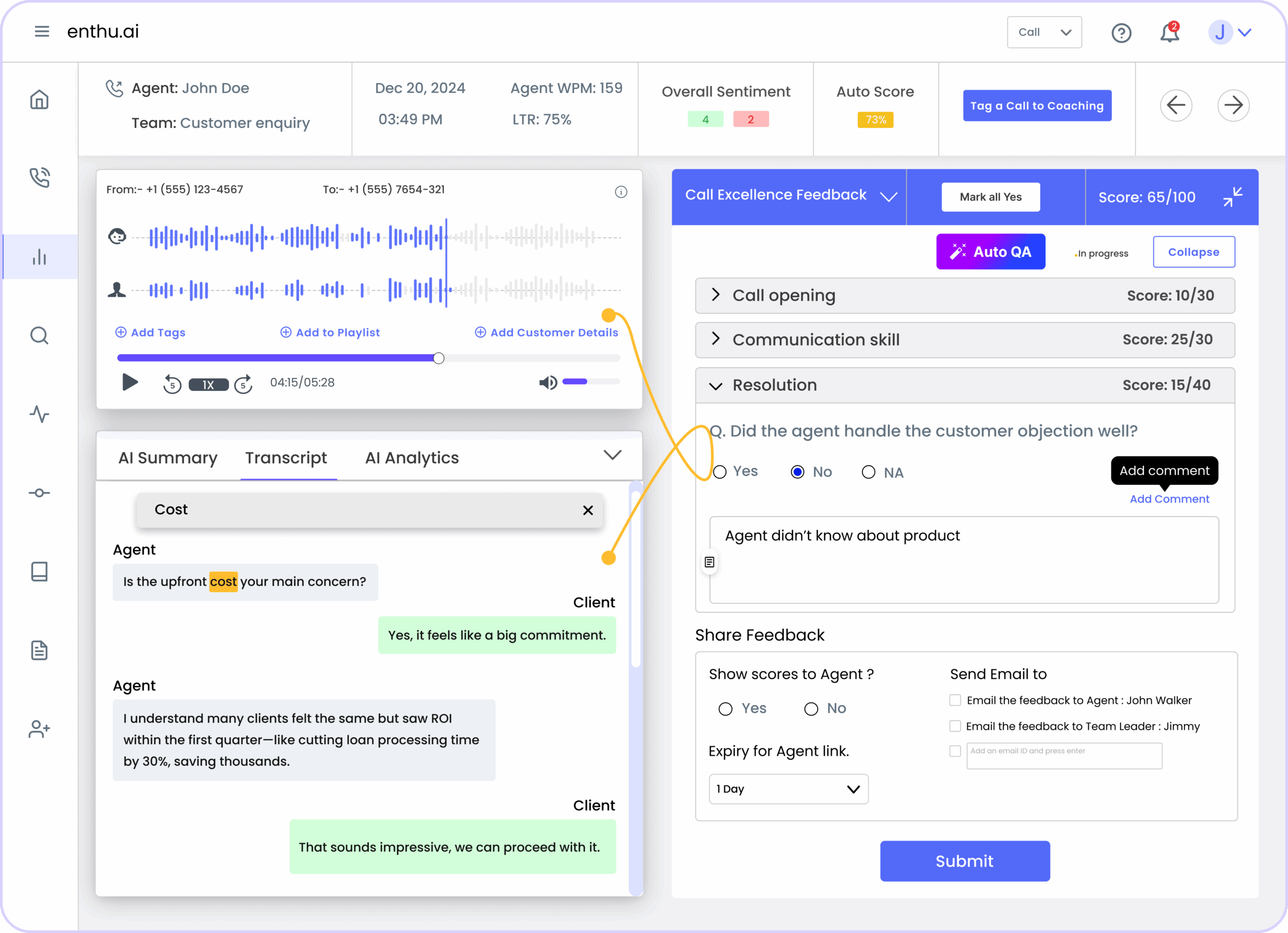
AI agents use intent recognition to determine what customers actually need. They analyze keywords, context, and conversation history to route calls intelligently.
Sentiment analysis adds another layer by detecting frustration or urgency in the customer’s tone. This helps prioritize escalations and match customers with the right agent expertise.
Intelligent AI-powered call routing improves first-call resolution and reduces call transfers more than menu-driven IVR systems.
3. Automation through RPA and business integrations
Robotic process automation enables AI agents to execute workflows across multiple systems. They can pull customer data from CRMs, update ticketing tools, and access knowledge bases automatically.
API integrations connect AI agents to your existing tech stack seamlessly. This includes phone systems, calendar tools, payment gateways, and internal databases.
The result is end-to-end process orchestration that eliminates manual data entry. Agents no longer waste time switching between screens or logging information.
4. Continuous learning through real call data
AI agents improve over time by analyzing actual customer interactions. Machine learning algorithms identify patterns and optimize responses based on successful outcomes.
Call analytics and insights help refine the AI’s understanding of edge cases. Teams can review flagged conversations and provide feedback to enhance accuracy.
This continuous improvement loop increases automation rates by 5-10% quarterly. The more calls your AI agent handles, the smarter it becomes.
C. Benefits of AI Agents in Call Centers
Discover measurable advantages from cost reduction to compliance improvements that directly impact your bottom line.
1. Lower operational costs & faster scaling
AI agents reduce contact center costs by 20-30% within the first year. They eliminate the need to hire additional staff during peak seasons or expansion phases.
Jose A SAENZ, CEO, Jump Contact Center, was monitoring just a handful of agent conversations and was looking at adopting a tech solution to monitor, evaluate and coach agents at scale.
“Implementing AI agents into our customers’ contact centers has driven a 40 percent reduction in AHT,” he says. He added, “Working with Enthu has given my agents trackable parameters to set benchmarks and continuously exceed them. Not only do I have a transparent view of my business now, my clients also see the amazing service that I deliver, nicely backed by data and stats.”
You can scale from handling 100 calls to 10,000 calls without proportional cost increases. The only investment required is in cloud infrastructure and licensing.
Companies report saving 15-20 hours per agent per week by automating routine inquiries. That time can be redirected to high-value activities like relationship building.
2. Improved first-call resolution (FCR)
Intelligent routing sends customers to the right resource immediately. This increases FCR rates by 25-40% compared to traditional call distribution.
AI agents access complete customer history instantly during calls. They can resolve issues without asking customers to repeat information.
Higher FCR directly impacts customer satisfaction scores and reduces repeat calls. Each percentage point improvement in FCR can save thousands in operational costs.
3. Automation of repetitive tasks & after-call work
Call summaries and transcriptions are generated automatically after every interaction. This eliminates 5-7 minutes of manual wrap-up time per call.
AI for sales and collections calls can automate follow-up scheduling and payment reminders. These tasks happen in the background without agent involvement.
Documentation accuracy improves significantly when AI handles note-taking. Agents can focus on active listening instead of typing during conversations.
4. Enhanced customer experience 24/7
Customers expect instant support regardless of time zones. AI agents provide consistent service quality at 3 AM just as well as at 3 PM.
Wait times drop to near zero when AI handles routine queries immediately. For urgent issues, customers get routed to human agents without delay.
Personalization improves when AI accesses customer data in real-time. The system can recommend products based on purchase history or address concerns proactively.
5. Better compliance & reduced risk
Fraud detection and compliance AI monitors 100% of calls for regulatory adherence. Human QA teams can only sample 2-5% of interactions.
AI agents follow scripts precisely and never forget compliance disclosures. This reduces legal risk and ensures consistent policy enforcement.
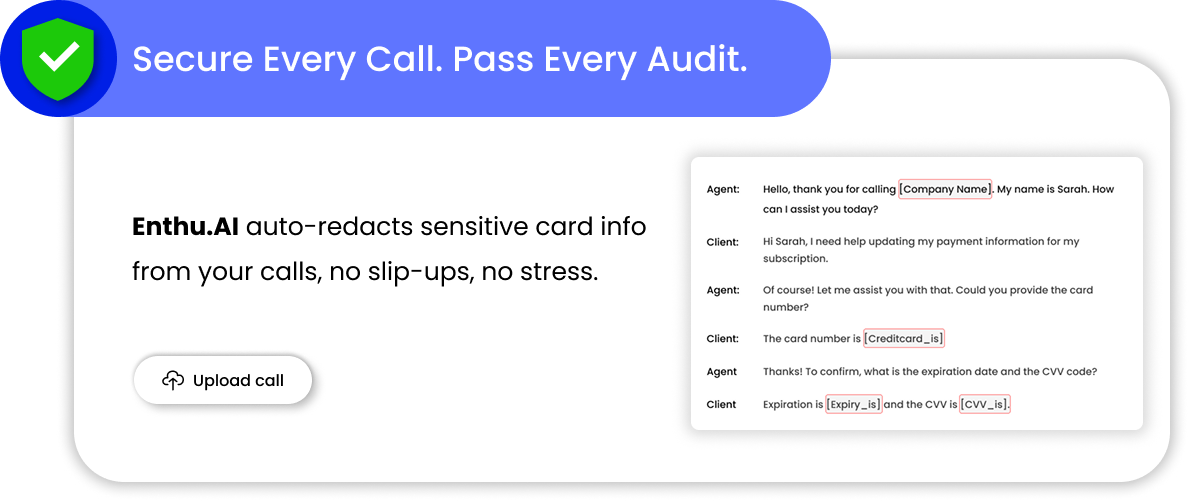
Automatic flagging of sensitive information protects customer data. The system can redact credit card numbers or personal details from recordings.
6. Boosted agent productivity through hybrid AI-human collaboration
AI copilot tools provide real-time suggestions during live calls. Agents get instant access to knowledge base articles without searching manually.
Sentiment alerts warn agents when customers are becoming frustrated. This allows for quick intervention before situations escalate.
New agents reach full productivity faster with AI assistance. The technology serves as an always-available mentor during their learning curve.
D. Core capabilities to look for in an call center AI agent
Identify essential features that separate effective AI solutions from underwhelming implementations in real-world contact centers.
1. Natural, human-like voice interactions
Modern voice AI should sound conversational, not robotic. Look for sub-second latency to maintain natural conversation flow.
The system should handle interruptions gracefully and adapt to different speaking styles. Voice quality matters significantly for customer acceptance.
Test the AI with real customer scenarios before committing. Poor voice quality can damage your brand perception more than help it.
2. Integration readiness (CRM, phone systems, ticketing)
Seamless CRM integration is non-negotiable for contextual conversations. Your AI agent needs real-time access to customer profiles and interaction history.
Pre-built connectors for popular platforms like Salesforce, Zendesk, and Microsoft Teams save months of development time. API flexibility allows custom integrations with proprietary systems.
Phone system compatibility ensures smooth call routing and recording. The AI should work with both cloud-based and on-premise PBX infrastructure.
3. Automatic call summaries & sentiment analysis
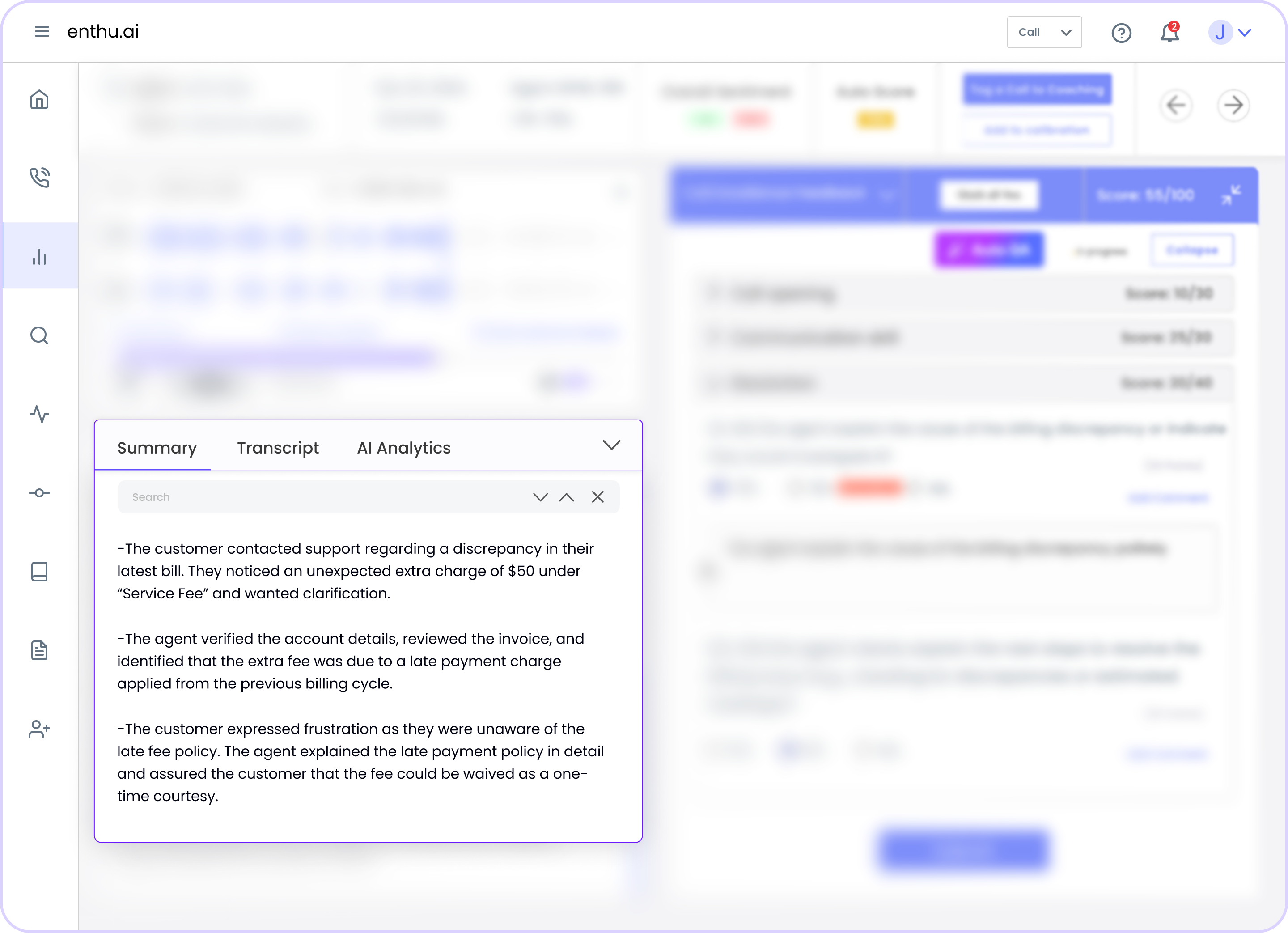
Every call should generate a structured summary with key points and action items. This creates a searchable repository of customer interactions.
Sentiment scoring helps identify at-risk accounts and improvement opportunities. Trend analysis reveals patterns across thousands of conversations.
Look for customizable sentiment categories that match your business needs. Generic positive/negative labels provide less value than specific metrics like “product complaint” or “pricing concern”.
4. Secure data handling and compliance certifications
SOC 2 and HIPAA compliance are essential for enterprise deployments. These certifications demonstrate robust security practices and regular audits.
Encryption for data at rest and in transit protects sensitive information. Role-based access controls limit who can view customer data.
Check whether the vendor stores data in your preferred geographic regions. This matters for GDPR and other regional privacy regulations.
5. Agent assist and real-time guidance features
Real-time coaching tools provide live feedback during customer calls. The AI can suggest better phrasing or remind agents about compliance requirements.
Knowledge retrieval surfaces relevant articles automatically based on conversation context. Agents don’t waste time searching while customers wait on hold.
Next-best-action recommendations guide agents through complex processes. This is particularly valuable for new hires still learning your procedures.
E. How AI agents in call center support human agents (not replace them)?
Understanding the collaborative partnership between artificial and human intelligence that delivers superior customer outcomes.
1. AI as a copilot for knowledge retrieval
Think of AI as your agents’ personal research assistant. It monitors conversations and pulls up relevant information proactively.
When a customer mentions a product issue, the AI displays troubleshooting guides instantly. Agents can focus on building rapport instead of database searches.
This copilot approach reduces average handling time by 20-30%. Customer satisfaction improves because agents sound more confident and knowledgeable.
2. Automating documentation and compliance checks
Post-call work drops dramatically when AI handles note-taking and data entry. Agents can move to their next call immediately.
Compliance verification happens in the background. The AI flags any missing disclosures or policy violations for manager review.
This automation saves 1-2 hours per agent per day on administrative tasks. That translates to 10-15% more customer interactions per shift.
3. Reducing burnout with smart workflows
Repetitive tasks are the leading cause of agent turnover. AI removes the monotony by handling routine inquiries automatically.
Agents can focus on interesting, complex problems that require human creativity. This makes their work more engaging and fulfilling.
Companies using AI can lower agent attrition rates. Happier agents deliver better customer experiences, creating a positive feedback loop.
F. Implementation guide: how to deploy an AI agent in your contact center
Following proven steps from vendor selection through pilot testing to ensure successful AI adoption.
1. Checklist for selecting an AI provider
Start by defining your specific use cases and success call center metrics. Do you need voice, chat, or omni-channel support?
Evaluate at least three vendors using pilot programs before final selection. Look for proven track records in your industry.
Check implementation timelines and support offerings. Some platforms can be configured in hours, while others take months.
2. Designing workflows and training AI for your business
Map out your most common call types and resolution paths. These become the foundation for your AI agent’s training.
Provide the AI with your knowledge base, policies, and historical call data. The more context you supply, the better it performs.
Start with narrow use cases like appointment booking or order status. Expand gradually as you build confidence in the system.
3. Pilot programs and success metrics
Run a pilot with 10-20% of your call volume for 4-6 weeks. Monitor metrics like automation rate, customer satisfaction, and escalation frequency.
Collect feedback from both customers and agents during the pilot. Their insights will guide your refinement process.
Set clear success criteria before launch. Common targets include 60% automation rate and maintaining CSAT above 4.0/5.0.
4. Change management and agent adoption
Communicate early and often about how AI will enhance agent roles. Address fears about job security transparently.
Involve agents in the design process to increase buy-in. Their frontline experience provides valuable input on edge cases.
Provide hands-on training and ongoing support. Agents should feel comfortable using AI tools before customer-facing deployment.
G. Common challenges & how to avoid AI agent deployment failures
Learning from implementation mistakes and technical pitfalls that derail AI projects before they deliver value. Here are some common challenges and tips for AI agent deployment failure.
1. Hallucinations and Accuracy Risks in LLMs
Large language models occasionally generate incorrect information confidently. This “hallucination” problem can damage customer trust.
How to avoid:
- Combat this by implementing strict fact-checking layers. Route uncertain queries to human agents automatically.
- Regularly audit AI responses and refine training data. Monitor accuracy metrics weekly during the first three months.
2. Data Silos and Integration Gaps
Disconnected systems prevent AI from accessing the complete customer context. This leads to repetitive questions and poor experiences.
How to avoid:
- Invest in proper integrations before launching AI agents. Unified customer data platforms eliminate silos effectively.
- API-based architectures provide flexibility for future additions. Plan for scalability from day one.
3. Lack of Measurement & ROI Visibility
Many AI projects fail because teams can’t demonstrate value. Without clear metrics, executives lose confidence quickly.
How to avoid:
- Establish baseline measurements before implementation. Track cost per interaction, resolution times, and CSAT consistently.
- Create monthly ROI dashboards that show progress visually. Tie improvements directly to business outcomes like revenue or retention.
4. Ethical and CX Safeguards
Customers feel frustrated when AI can’t understand regional accents or dialects. This creates accessibility barriers and potential discrimination.
How to avoid:
- Test your AI agent with diverse user groups before full rollout. Provide easy escalation paths to human agents.
- Be transparent about AI usage in your customer interactions. Most people accept AI support when expectations are set clearly.
Getting started with Enthu.AI’s call center AI agents
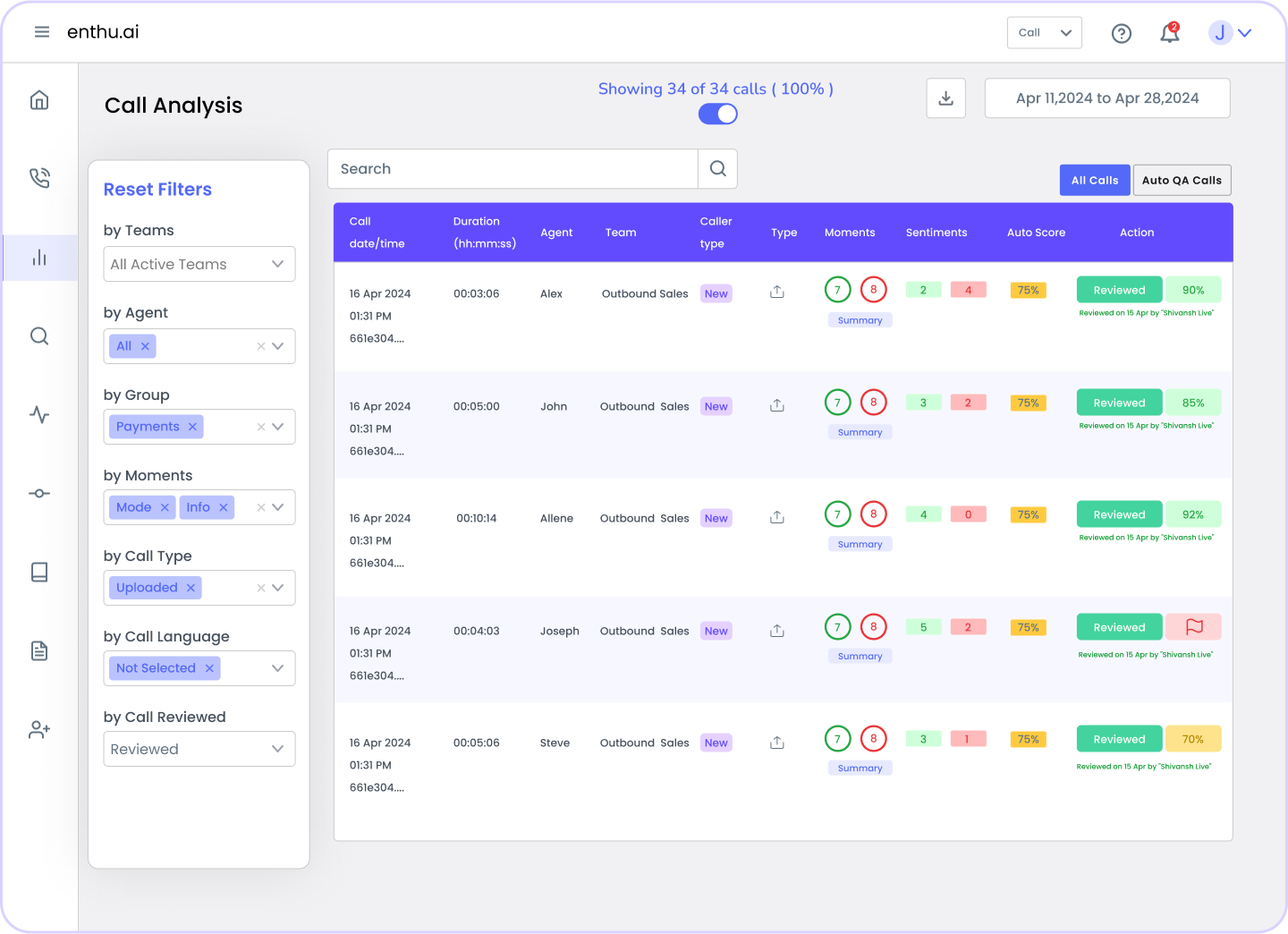
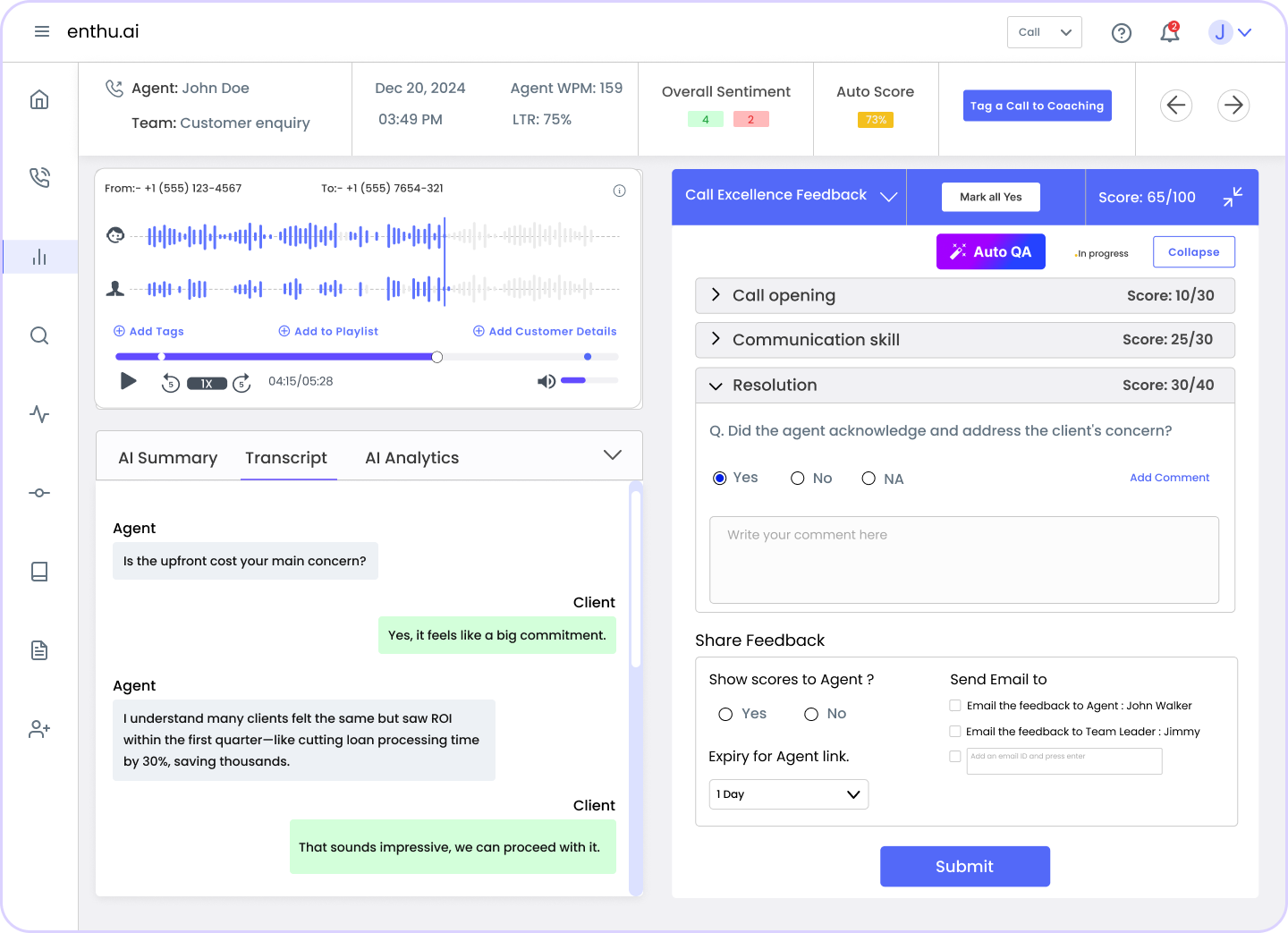
Enthu.AI is an agentic AI for contact center intelligence that automates your workflows with intelligent AI agents built specifically for QA, CSAT monitoring, and real-time assistance. Our platform transcribes every conversation with speaker labels and precise timestamps, making review and analysis effortless.
Here’s how Enthu.AI transforms your operations:
- Transcribe with industry-leading accuracy: Our AI transcription engine handles industry-specific terminology with exceptional precision. Unlike generic solutions, Enthu.AI learns your business vocabulary and maintains 98%+ accuracy even in noisy environments.
- Auto-generate actionable summaries: Every call produces a structured summary highlighting key points, customer concerns, and next steps. Your agents save 5-7 minutes per call on documentation while improving record quality.
- Analyze & auto-score at scale: Enthu.AI evaluates 100% of interactions using customizable scorecards across empathy, compliance, and script adherence. QA teams reduce review time by 90% while gaining deeper insights into performance patterns.
- Act & improve with real-time feedback: Identify coaching opportunities instantly with sentiment alerts and compliance flagging. Our fraud detection and compliance AI monitors every call for regulatory adherence and risk indicators.
Ready to see the difference?
Ask for a FREE demo today!
FAQs
1. What is an AI agent for call centers?
An AI agent is a virtual assistant using artificial intelligence to handle customer interactions autonomously. It manages voice and chat conversations, routes calls intelligently, and automates routine tasks without human intervention.
2. How much can AI agents reduce call center costs?
AI agents typically reduce operational costs by 20-30% within the first year. They eliminate hiring needs for routine queries and save 15-20 hours per agent weekly on repetitive tasks.
3. Can AI agents replace human call center agents?
No, AI agents complement human agents rather than replace them. They handle routine inquiries while humans focus on complex, emotional, or unique situations requiring judgment and empathy.