What is conversation intelligence?
Conversation intelligence is an AI-powered technology that automatically transcribes and analyzes voice conversations to extract measurable business insights.
This technology transforms sales calls, customer service interactions, and team meetings into structured data you can search, analyze, and act upon.
Unlike traditional call recording that simply stores audio files, conversation intelligence actively processes every word spoken. It identifies customer sentiment, tracks specific keywords, flags competitor mentions, and highlights moments that matter to your business.
The technology works across multiple channels – phone calls, video meetings on Zoom or Microsoft Teams, chat platforms, and email exchanges. Advanced natural language processing (NLP) and machine learning algorithms analyze both what customers say and how they say it. This dual analysis reveals not just surface-level metrics but deep behavioral patterns that drive business outcomes.
Related: 10 Best Conversation Intelligence Software For 2026.
Why is conversation intelligence important?
Conversation intelligence eliminates this gap by analyzing every interaction and revealing patterns that drive business outcomes.
Organizations that adopt conversation intelligence tools can:
1. Eliminating blind spots in customer interaction
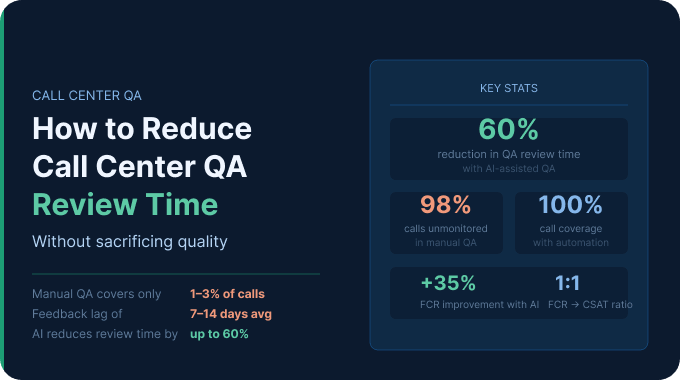
Your sales managers can manually review maybe 2-3% of total customer calls. That means 97% of conversations go unanalyzed, hiding critical insights about why deals close or fall apart.
Conversation intelligence monitors 100% of interactions automatically. It catches patterns invisible to human reviewers like customers who mention pricing three times before objecting, or specific phrases that correlate with closed deals. This complete visibility transforms guesswork into data-driven strategy.
2. Speed-to-insight: From hours to seconds
Traditional conversation review takes hours per call. Sales reps spend 20-30 minutes manually transcribing notes, then managers need another 45 minutes to analyze and provide feedback.
Conversation intelligence delivers instant summaries the moment a call ends. AI extracts key moments, action items, and sentiment scores in seconds. Your team accesses insights while the conversation is still fresh, enabling same-day coaching instead of delayed feedback that loses impact.
3. Data-driven decision making
Gut feelings drive most sales strategies. Managers assume they know what messaging works based on limited observations and top performer anecdotes.
Conversation intelligence replaces assumptions with hard data. You see exactly which questions lead to closed deals, which objections predict churn, and which competitors get mentioned most frequently.
A leading contact center “Jump Contact” reduced AHT by 40% and improved SLA adherence to 100% with Enthu.AI’s conversation intelligence feature – an insight impossible to spot without analyzing thousands of calls.
How does conversation intelligence work?
The technology behind conversation intelligence combines multiple AI capabilities to transform raw audio into actionable data. From speech recognition to sentiment detection, each component works together to extract meaning from every customer interaction in real-time.
Organizations implementing conversation intelligence technology can:
1. Data capture & aggregation
The system starts by recording conversations from multiple sources simultaneously. Phone systems, video conferencing platforms like Zoom and Microsoft Teams, chat applications, and email threads all feed into a centralized database.
Modern platforms capture conversations without manual intervention. Integration happens through APIs and pre-built connectors that sync automatically with your existing tech stack. Your sales reps simply conduct calls normally – the platform handles recording, storage, and initial processing in the background.
2. High-fidelity transcription & NLP
Advanced speech recognition technology converts audio into searchable text with 95%+ accuracy. The system handles multiple speakers, background noise, accents, and technical terminology without human assistance.
Natural language processing then analyzes the transcript to extract meaning. NLP identifies context around keywords – distinguishing between “pricing is great” versus “pricing is too high” even though both contain the word “pricing”. This contextual understanding separates modern conversation intelligence from simple keyword-matching tools.
3. Speaker diarization
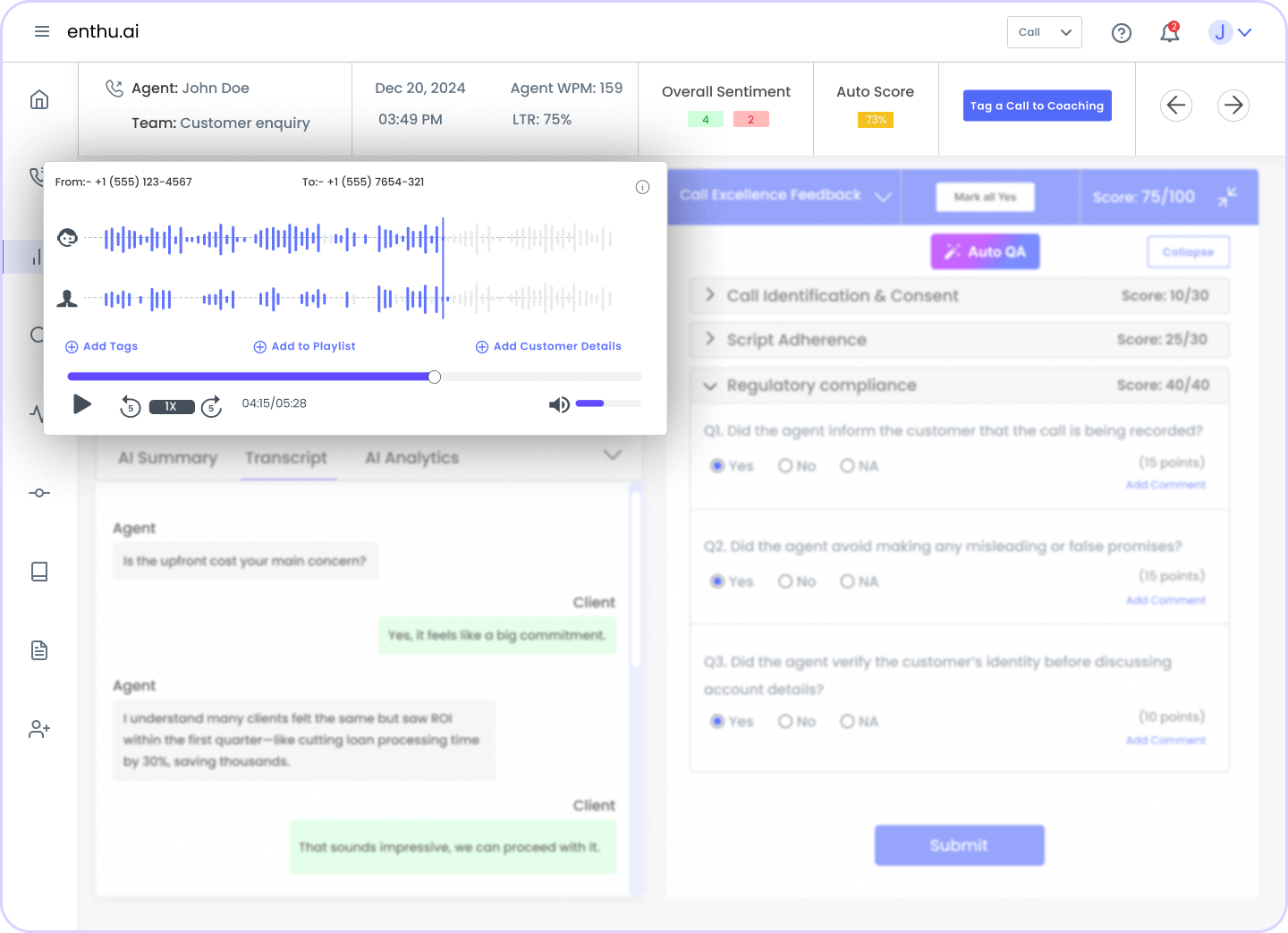
The platform identifies and labels different speakers throughout the conversation. It distinguishes between your sales rep, the customer, and any additional participants joining the call.
This capability enables critical metrics like talk-to-listen ratios. You discover whether your reps dominate conversations or practice active listening. Research shows top-performing sales reps maintain a 43:57 talk-to-listen ratio, letting customers speak slightly more than they do.
4. Sentiment analysis & tone detection
AI algorithms assess emotional tone throughout the conversation. The system detects frustration, enthusiasm, confusion, satisfaction, and other emotional states based on word choice, speaking pace, and vocal patterns.
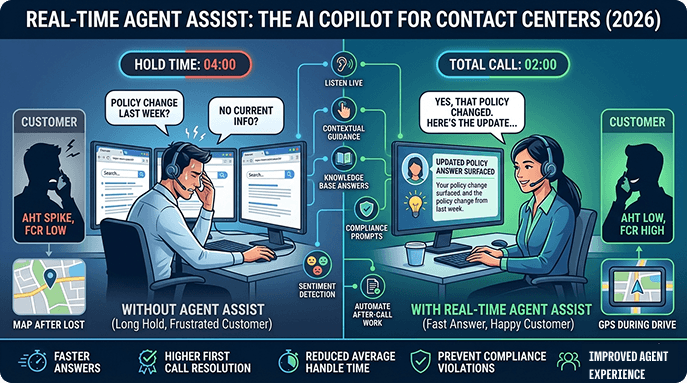
Sentiment tracking happens in real-time during live calls. If customer frustration spikes, the platform can alert supervisors to join the call or prompt the agent with suggested responses. Post-call, sentiment trends reveal which conversation moments correlate with positive or negative outcomes.
5. CRM integration
Conversation intelligence platforms sync bidirectionally with CRM systems like Salesforce. Call summaries, action items, and key insights automatically populate deal records without manual data entry.
This integration creates a complete customer interaction history. Your team sees not just CRM notes but actual conversation excerpts, sentiment scores, and engagement metrics attached to every opportunity. Sales leaders access dashboard analytics showing conversation trends across their entire pipeline.
Conversation intelligence vs. conversation analytics: What’s the difference?
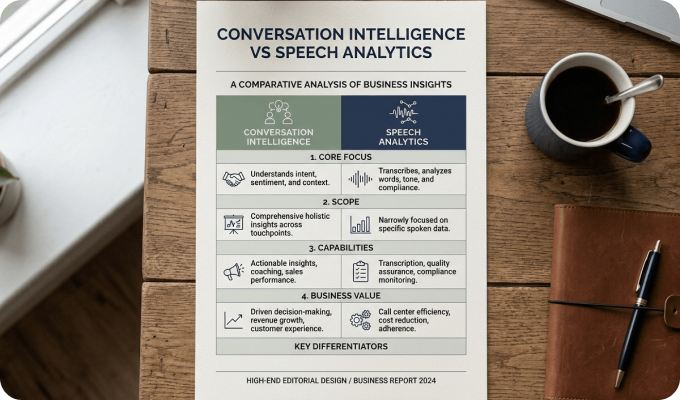
Many vendors use these terms interchangeably, but they represent fundamentally different analytical depths. One tells you what happened; the other explains why it matters and what to do next.
Here are some differences between the two:
1. Analytics looks at the ‘what’ (The data)
Conversation analytics focuses on quantitative metrics. It tracks call duration, total call volume, keyword frequency, and basic performance indicators.
An analytics report might show: “Average call duration was 18 minutes. The word ‘pricing’ appeared 47 times this week. Call volume increased 12% month-over-month”. These metrics describe activity but don’t explain causation or recommend actions.
2. Intelligence looks at the ‘why’ (The insight)
Conversation intelligence adds prescriptive and predictive layers. It explains why certain conversations succeed, predicts which deals will close based on conversation patterns, and recommends specific actions to improve outcomes.
Your top objection this month is implementation timeline – address it proactively in discovery calls”.
Comparison Table: Analytics vs. Intelligence
| Dimension | Conversation Analytics | Conversation Intelligence |
| Primary Focus | What happened (metrics) | Why it happened + what to do next |
| Output Type | Descriptive statistics | Actionable insights & recommendations |
| Technology | Basic keyword tracking | NLP, ML, sentiment analysis |
| Analysis Depth | Surface-level patterns | Deep behavioral insights |
| Strategic Value | Reporting & monitoring | Decision-making & optimization |
| Use Case Example | “50 calls mentioned competitors” | “Calls mentioning Competitor X need ROI comparison in slide 7” |
Who is conversation intelligence for?
Conversation intelligence delivers value far beyond the sales floor. Marketing teams refine messaging, product managers gather unfiltered feedback, and customer success teams spot churn risks – all from the same conversation data.
Teams across your organization using conversation intelligence can:
1. Sales coaching & enablement
Sales managers gain objective coaching data beyond subjective observations. The platform identifies specific moments where reps excel or struggle like handling objections, building rapport, or closing techniques.
New sales reps onboard 50% faster when trained with conversation intelligence. Instead of generic training modules, they review actual successful calls from top performers, seeing exactly what questions to ask and how to navigate tough conversations.
2. Marketing strategy & messaging
Marketing teams discover the actual language customers use to describe problems. If sales calls reveal customers say “data chaos” instead of your marketing term “information management challenges,” you adjust messaging to match real-world vocabulary.
Conversation intelligence also validates which value propositions resonate. You see whether customers respond better to ROI arguments, ease-of-use benefits, or competitive differentiation, then optimize campaigns accordingly.
3. Product feedback & roadmap prioritization
Product managers access unfiltered customer feedback at scale. Instead of waiting for quarterly surveys, they hear daily conversations revealing feature requests, usability frustrations, and competitive gaps.
A US based real estate company improved lead qualification rate by 50% using conversation analysis. Enthu.AI enables the customer with multiple data exchanges and cross platform intelligence sharing, without them spending even a single minute of effort.
4. Customer success & churn prevention
Customer success teams identify at-risk accounts before they cancel. Conversation intelligence flags warning signals like decreased engagement, mentions of competitors, or negative sentiment trends across multiple touchpoints.
Proactive outreach based on these signals reduces churn by 15-20% compared to reactive strategies. You address concerns while relationships are still salvageable rather than scrambling after cancellation notices arrive.
Key benefits & metrics to track
The right metrics transform conversation intelligence from interesting insights into measurable business improvements. Here are some conversation intelligence metrics organizations are tracking:
1. Optimizing the talk-to-listen ratio
Top sales performers maintain specific talk-to-listen ratios depending on call stage. Discovery calls work best at 30:70 (rep talks 30% of the time), while closing calls shift to 55:45.
Conversation intelligence tracks this ratio automatically for every call. You identify reps who talk too much – overwhelming prospects with information – or too little, failing to guide the conversation toward outcomes.
2. Patience & interruption rate
Interruption frequency directly correlates with customer satisfaction. The platform counts interruptions per call and highlights patterns.
Sales leaders coach reps struggling with patience, showing specific conversation moments where they cut off customers mid-sentence. Reducing average interruptions from 6 per call to 2 per call improves close rates by 9% based on industry benchmarks.
3. Automated keyword & competitor tracking
Manual competitor tracking misses 70% of competitor mentions in sales calls. Reps forget to log them in CRM or don’t recognize oblique references like “the tool we’re currently evaluating”.
Conversation intelligence catches every competitor mentioned automatically. It identifies not just direct name-drops but contextual references and related products. You discover which competitors appear most frequently in your pipeline, what objections they raise, and which competitive positioning works best to overcome them.
4. Automated conversation categorization
Platforms automatically tag conversations by type – discovery call, demo, negotiation, support issue, renewal discussion. This categorization enables comparative analysis across call types.
You benchmark performance by category. Maybe your team excels at discovery calls but struggles with pricing negotiations. Category-specific coaching addresses these gaps precisely rather than applying generic sales training that misses actual weaknesses.
Choose the right conversation intelligence software for your business
Selecting the right conversation intelligence platform comes down to three critical factors: deployment speed, AI accuracy, and actionable insights.
Look for platforms that integrate within weeks through pre-built connectors, achieve 95%+ transcription accuracy across accents and industry terminology, and deliver specific recommendations, not just data dumps.
Enthu.AI checks all these boxes while specializing in contact center operations. The platform deploys in hours, automatically scores 100% of calls against your quality parameters, and delivers real-time agent assistance during customer interactions.
Ready to see conversation intelligence in action?
Request a personalized Enthu.AI demo and discover how to automate 100% of your call quality assurance.
Start with a free 14-day pilot.
FAQs
1. What's the difference between conversation intelligence and conversational AI?
Conversational AI refers to chatbots and virtual assistants that engage in conversations. Conversation intelligence analyzes human-to-human conversations to extract insights. One creates automated dialogues; the other studies real conversations to improve business outcomes.
2. How accurate is conversation intelligence transcription?
Modern platforms achieve 95-98% transcription accuracy using advanced speech recognition. Accuracy improves over time as machine learning models learn your industry terminology, accents, and common phrases. Most platforms allow manual corrections that further train the AI.
3. Does conversation intelligence work for remote teams?
Yes, conversation intelligence integrates with video conferencing platforms like Zoom, Microsoft Teams, and Google Meet. Remote conversations are captured and analyzed identically to phone calls. Many organizations adopted conversation intelligence specifically to maintain coaching quality when teams went remote.

 On this page