A. What is sentiment analysis in customer experience?
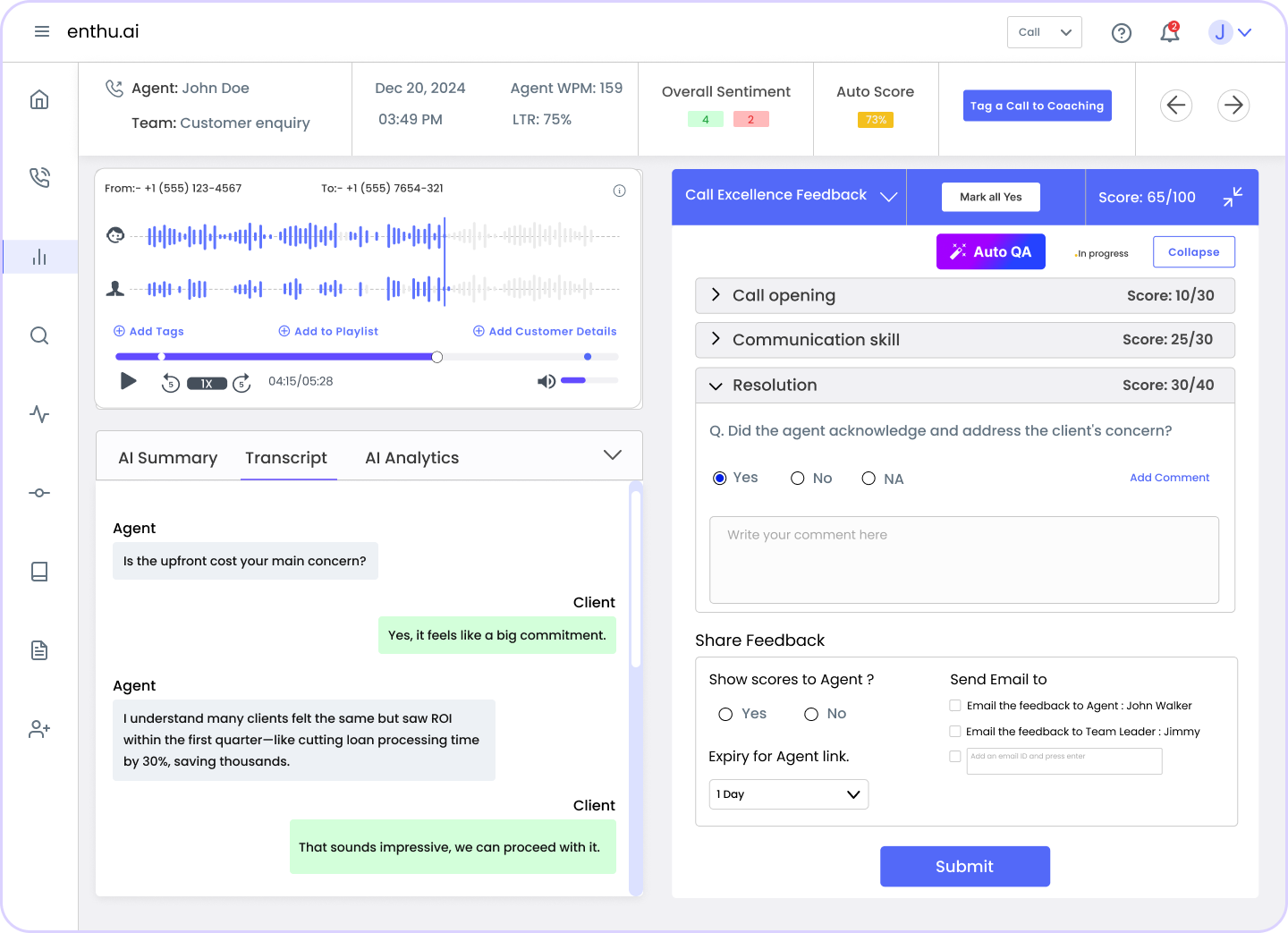
Sentiment analysis is the process of using Natural Language Processing (NLP) and Machine Learning (ML) to interpret emotional tone in customer interactions. It automatically classifies text or speech as positive, negative, or neutral while detecting nuanced emotions like frustration, satisfaction, or urgency.
Unlike traditional surveys that ask “How did we do?”, sentiment analysis captures emotion as it happens during the call, chat, or email exchange. This real-time visibility lets you intervene when it matters most, not days later when reviewing feedback reports.
Understanding what AI transcription is becomes essential here, as accurate speech-to-text conversion forms the foundation for effective sentiment analysis in voice channels.
B. How does modern sentiment analysis work?
Understanding the technology helps you evaluate tools and set realistic expectations. Here’s how modern customer sentiment analysis work:
1. Text classification
Basic sentiment analysis categorizes text into three classes: positive, negative, or neutral. Machine learning models trained on millions of labeled examples learn patterns associating specific language with sentiment categories.
These models analyze not just individual words but phrases, context, and sentence structure to make classifications.
Example: A statement like “The product works” might be neutral, while “The product actually works!” shows positive surprise.
2. Emotion and intent detection
Advanced sentiment analysis goes beyond positive/negative to identify specific emotions: frustration, anger, joy, confusion, disappointment, relief, or urgency.
These granular emotions provide richer context for responses.
Example: An angry customer needs different handling than a confused one, even if both are “negative.” Intent detection adds another layer, identifying whether customers want information, resolution, refunds, or escalation.
3. Aspect-based sentiment analysis
Aspect-based sentiment analysis identifies what specifically customers feel emotional about, not just overall sentiment. A customer might love your product but hate your billing process.
Example: Aspect-based approaches separate these dimensions, showing that product sentiment is +8/10 while billing sentiment is -6/10.
This specificity directs improvement efforts to areas driving the most emotional friction.
4. Large language models (LLMs)
Traditional ML sentiment models require extensive training on labeled datasets and perform well on specific use cases they’re trained for. LLMs like GPT-4 bring broader language understanding with less specialized training.
With computation resources and prompt engineering, LLMs excel at understanding nuance, context switching, and rare expressions that traditional models miss.
Our guide on conversation intelligence software explores how platforms integrate these technologies.
5. Accuracy, bias, and transparency challenges
No sentiment model is perfect. Sarcasm, cultural differences, and context-dependent language create challenges even for advanced AI. Models may perform differently across customer segments, especially with non-native speakers or regional dialects.
Bias can emerge when training data overrepresents certain demographics or use cases. Responsible implementation requires ongoing validation, diverse training data, and human oversight for high-stakes decisions.
Transparency matters too. Agents and customers should understand when AI influences interactions and how to request human judgment when needed.
C. How sentiment analysis improves customer experience?
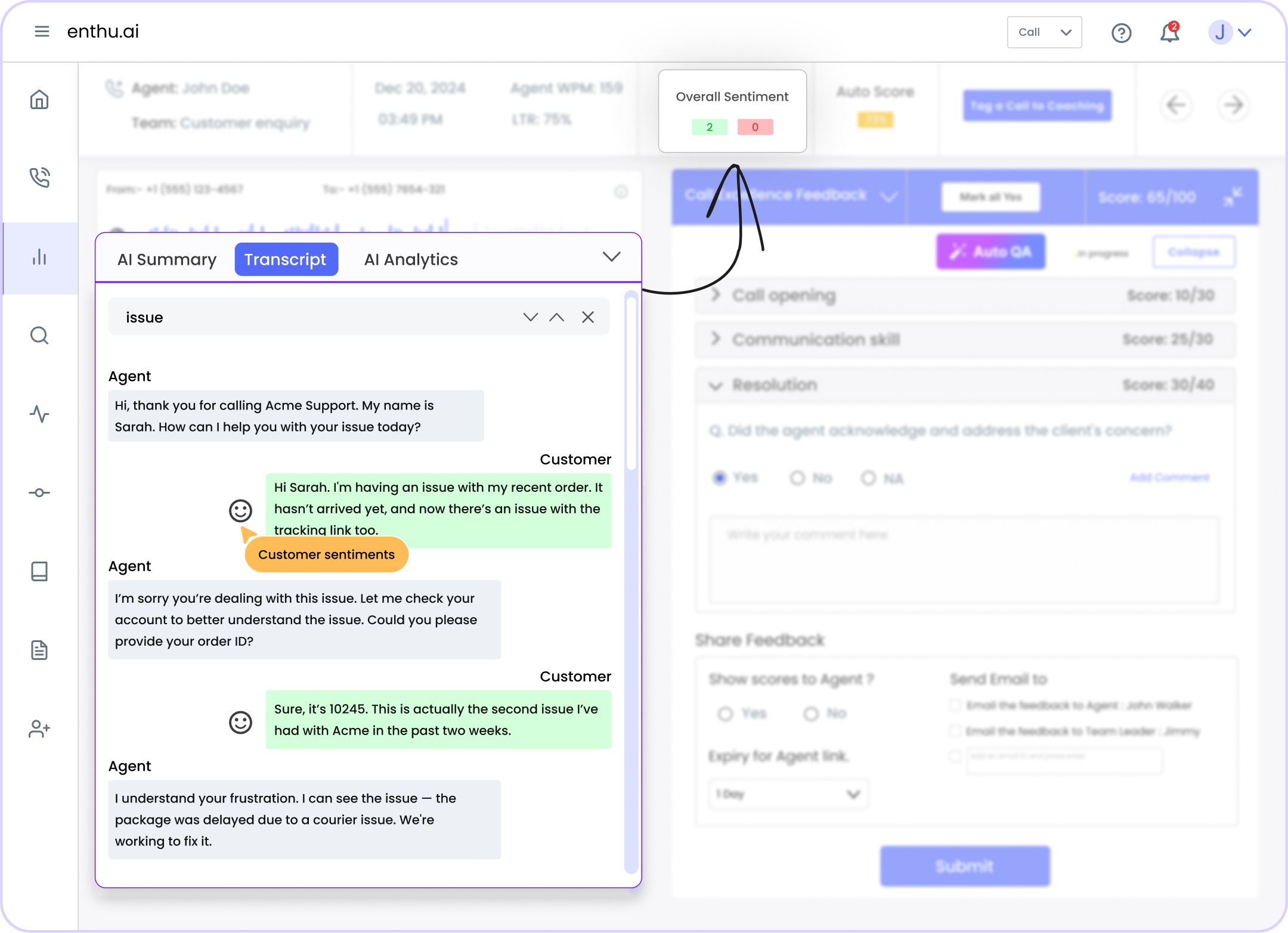
From detecting frustrated customers in real time to preventing churn before it happens, sentiment analysis powers smarter customer interactions. Here are seven proven use cases where emotion intelligence drives tangible CX results:
1. Identifying customer pain points in real time
Real-time sentiment detection spots problems as they develop, not after customers hang up disappointed.
When a customer’s tone shifts from neutral to frustrated mid-conversation, sentiment analysis flags the interaction immediately.
Supervisors receive instant alerts showing the conversation context, emotional trajectory, and suggested interventions. This enables proactive issue resolution – addressing concerns before customers escalate to social media or request to speak with managers.
2. Detecting high-risk
Not all negative interactions carry equal risk. Customer sentiment analysis weighs both emotional intensity and customer value to prioritize responses strategically.
High-value accounts showing emotional decline across repeated interactions trigger automated workflows – callbacks from senior agents, executive outreach, or retention offers.
Voice analytics detect stress signals in tone and speech patterns, even when customers don’t explicitly express dissatisfaction. This early warning system prevents cancellations by enabling intervention at the first sign of trouble, not after customers have already decided to leave.
3. Enhancing contact center quality assurance
Traditional QA reviews 1-2% of interactions through manual sampling. Sentiment analysis enables intelligent sampling by automatically prioritizing calls with negative sentiment, compliance concerns, or unresolved issues.
Quality managers focus on interactions that truly need attention rather than reviewing random samples that tell you little. This targeted approach improves coaching effectiveness while reducing QA workload..
4. Powering personalized customer interactions
When sentiment analysis detects a frustrated customer, the system can automatically adjust chatbot tone, offer human escalation paths, or prioritize the ticket in the queue.
For satisfied customers, it can trigger upsell recommendations or loyalty program invitations at emotionally optimal moments.
This dynamic personalization increases conversion rates while improving satisfaction. Customers feel understood rather than processed through generic scripts, creating experiences described in our customer experience management guide.
5. Streamlining support ticket prioritization
Email and ticket backlogs hide critical issues among routine inquiries. Sentiment analysis surfaces urgent tickets automatically based on emotional cues rather than keywords alone.
A support request stating “I’ve tried everything and nothing works” carries higher emotional urgency than “I have a question about my account,” even though neither uses explicit priority language. AI detects this urgency through context and routes accordingly.
This intelligent routing reduces average response times for high-emotion tickets while ensuring routine inquiries still get handled efficiently.
6. Improving product & service feedback loops
Sentiment analysis processes thousands of survey responses, support tickets, and chat transcripts to identify patterns traditional analysis misses.
When negative sentiment clusters around specific product features, versions, or processes, product teams get actionable insights with statistical significance.
Enthu.AI’s reporting and analytics platform connects sentiment trends to business outcomes, showing exactly which emotional patterns correlate with churn, upsells, or retention.
7. Reducing customer effort through predictive insights
By analyzing emotional patterns across customer journeys, AI identifies accounts at risk of churning before cancellation requests arrive.
Predictive models spot when sentiment scores decline across repeated interactions, triggering proactive retention workflows.
These early interventions recover customers who would have churned silently, improving retention rates in some organizations.
D. Channel-Specific Applications of Sentiment Analysis
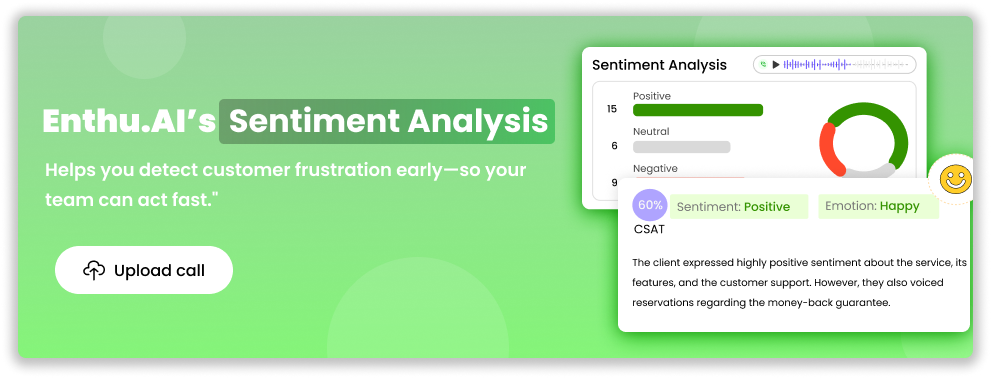
Different channels carry different emotional signals requiring specialized analysis approaches. Here are five critical channels where emotion detection transforms customer interactions:
1. Voice calls – tone, emotion, and stress signal detection
Voice contains rich emotional data beyond words – tone, pitch, speaking rate, and silence duration all signal customer state.
Voice sentiment analysis captures these acoustic features to detect stress, frustration, or satisfaction even when customers maintain polite language.
Real-time voice analysis alerts supervisors to escalating calls, enabling immediate intervention through whisper coaching or call takeover. This prevents negative experiences from spiraling while customers are still on the line.
2. Email & ticketing – identifying urgency and frustration
Email lacks voice cues but carries sentiment through language choice, punctuation, and message structure. Sentiment analysis detects implicit urgency in phrases like “still waiting,” “third time,” or “extremely disappointed.”
Text sentiment analysis also identifies sarcasm when customers write “Thanks for nothing” or “Great service,” the AI correctly classifies these as negative despite positive keywords.
This contextual understanding prevents misrouting and inappropriate automated responses.
3. Chat & messaging – fast emotion classification at scale
Sentiment analysis processes every chat message within milliseconds, enabling dynamic response adjustment mid-conversation.
When frustration is detected, chatbots can automatically offer human escalation or modify their tone. When satisfaction is high, they can introduce upsell opportunities or request reviews.
The speed of chat sentiment analysis enables emotion-aware automation at scale – handling thousands of simultaneous conversations with appropriate emotional intelligence.
4. Social media listening – brand health & crisis detection
Sentiment analysis monitors brand mentions across platforms, alerting teams to sentiment spikes that signal viral issues or emerging crises.
This social listening capability provides early warning when product launches receive negative reactions, service outages spark customer anger, or competitive moves shift market perception. Brands can respond proactively before situations escalate.
5. Surveys & NPS/CSAT – turning text responses into insights
Sentiment analysis processes thousands of verbatim comments, categorizing them by theme and emotional intensity.
This transforms unstructured feedback into actionable intelligence showing which issues drive detractors versus promoters. Teams identify opportunities to move neutral customers to promoters by addressing specific friction points revealed through sentiment patterns.
Understanding critical call center metrics like CSAT and NPS becomes more actionable when combined with sentiment insights.
E: What are real business benefits of sentiment analysis?
Sentiment analysis delivers measurable ROI across every dimension of customer experience. Here are some top benefits of customer sentiment analysis:
1. Higher CSAT, NPS, and customer loyalty
Sentiment analysis reveals exactly what drives satisfaction.
Companies identify pain points in real-time, address frustrations before they escalate, and consistently deliver experiences customers actually want.
Result?
Scores climb, loyalty strengthens, and customers become advocates who stick around and recommend you.
2. Faster resolution times and lower handle times
Sentiment-based routing connects customers with the right agents immediately based on emotional state, not just issue category.
Frustrated customers reach experienced agents qualified to de-escalate, while satisfied customers with simple questions get fast self-service options.
This intelligent routing reduces Average Handle Time by optimizing agent-customer matches. Contact centers using sentiment-driven workflows report 30% operational cost reductions through improved efficiency.
3. Increased sales and upsell opportunities
Sentiment analysis identifies emotionally optimal moments for sales conversations.
When customers express satisfaction or excitement, sentiment analysis tools alert agents to upsell opportunities with high conversion probability.
Conversely, the system prevents tone-deaf sales pitches to frustrated customers, protecting relationships and brand perception. This emotional timing increases upsell acceptance rates while maintaining customer trust.
4. Reduced churn through early warning signals
Sentiment analysis detects churn risk through emotional pattern recognition across interaction history.
When customer sentiment declines across repeated contacts, automated workflows trigger retention interventions – personalized outreach, special offers, or executive involvement.
Organizations using predictive sentiment scoring report 25% churn reduction by addressing dissatisfaction before cancellation requests arrive. This proactive retention is far more cost-effective than win-back campaigns after customers leave.
5. Improved agent performance and coaching outcomes
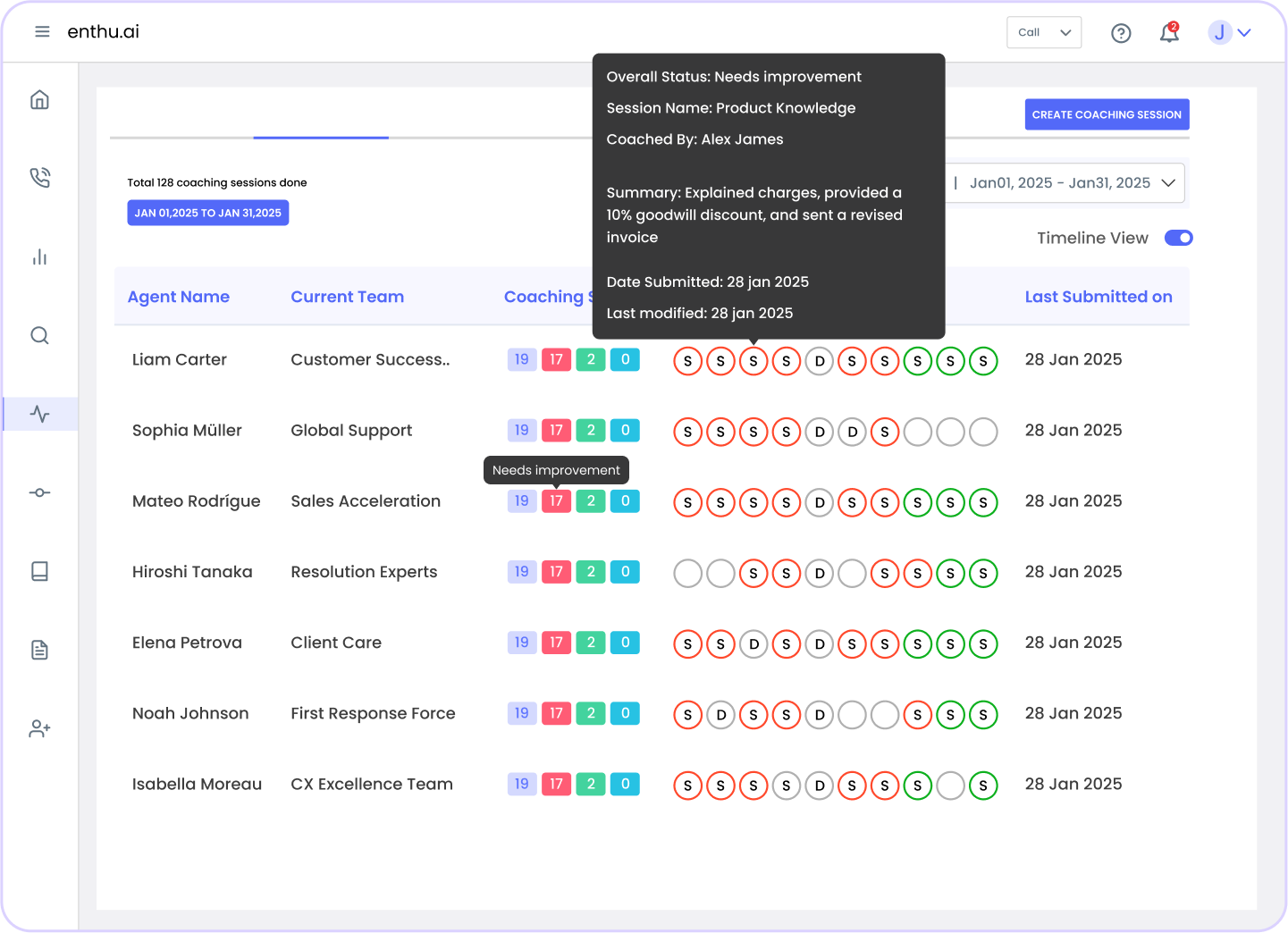
Generic training tells agents to “be empathetic.” Sentiment-based coaching shows them exactly where empathy succeeds or fails in their actual conversations.
Agent coaching platforms such as Enthu uses sentiment data to create targeted development plans – showing agents specific moments when tone shifted negatively and providing techniques to improve emotional management.
This data-driven coaching improves agent performance metrics while reducing turnover by giving clear, actionable feedback instead of subjective criticism.
6. Stronger cross-functional decision making (product, Ops, CX)
Sentiment data creates a shared truth across departments.
Product teams prioritize features customers emotionally need. Operations adjust processes causing frustration. CX strategies align with actual customer feelings.
Everyone stops guessing and starts deciding based on what customers genuinely experience and express.
F. How to implement sentiment analysis in your customer experience strategy
Strategic implementation turns sentiment technology into business transformation. Here are the transformative use cases changing how organizations serve customers:
Step 1 – Identify the right CX goals (retention, speed, quality, etc.)
Start by defining what success looks like.
Are you primarily focused on reducing churn, improving CSAT, accelerating resolution times, or enhancing agent performance?
Different goals require different sentiment applications:
- Churn reduction needs predictive sentiment scoring across customer lifetime.
- CSAT improvement requires real-time intervention capabilities.
- Agent development needs sentiment-tagged interaction recordings for coaching.
Clear goals guide tool selection, implementation priorities, and success metrics.
Step 2 – Choose the right data sources (voice, chat, surveys, etc.)
Identify which channels carry the most valuable emotional signals for your business.
B2B companies might prioritize voice and email sentiment. E-commerce brands might focus on chat and social media.
Start with channels where negative sentiment has the highest business impact – usually voice for high-value accounts and chat for volume-driven operations. Expand to additional channels once initial implementations prove value.
Step 3 – Select tools and platforms (manual, ML, or LLM-powered)
Evaluate sentiment analysis platforms based on accuracy, integration capabilities, real-time processing, and industry-specific requirements.
Enthu combines LLM-powered sentiment analysis with contact center-specific features like quality scoring, compliance monitoring, and agent coaching, all in an integrated system. This eliminates data silos and enables seamless workflows from detection to intervention.
Look for platforms offering API-driven integration with your existing CX stack, automated documentation for compliance, and scalability to handle millions of interactions.
Step 4 – Define metrics & KPIs
Establish baseline measurements before implementation so you can prove ROI. Key metrics to track include:
- Sentiment distribution (% positive, negative, neutral across channels)
- Sentiment-to-outcome correlations (how sentiment scores predict CSAT, NPS, churn)
- Intervention effectiveness (resolution rates when sentiment alerts trigger actions)
- Agent sentiment coaching impact (performance changes after targeted training)
Enthu.AI’s analytics dashboards track these metrics automatically, showing real-time sentiment trends alongside traditional contact center KPIs like FCR, AHT, and CSAT.
Step 5 – Operationalize insights across teams (QA, agents, product)
Technology alone doesn’t improve experience, teams using insights do. Build workflows that turn sentiment signals into concrete actions:
- QA teams receive prioritized interaction lists based on sentiment flags
- Supervisors get real-time alerts for escalating conversations requiring intervention
- Agents see sentiment scores during interactions with suggested response adjustments
- Product teams receive weekly reports on feature-specific sentiment patterns
Cross-functional visibility ensures everyone works from the same emotional intelligence rather than departmental silos.
Step 6 – Continuously refine models and workflows
Sentiment models improve through ongoing training and validation. Regularly review false positives (neutral interactions flagged as negative) and false negatives (missed frustration) to identify improvement opportunities.
Collect agent feedback on sentiment accuracy – frontline teams often spot nuances AI misses. Use this feedback to retrain models and adjust classification thresholds.
Workflow refinement is equally important. Track which sentiment-triggered interventions succeed versus which create unnecessary escalations, then optimize routing rules accordingly.
G: Overcoming common challenges when using sentiment analysis
Implementation success requires addressing predictable obstacles. Here are the five most common obstacles and how leading organizations overcome them:
1. Handling sarcasm, nuance, and implicit emotion
Challenge: AI struggles with sarcasm like “Great, another hour on hold” – reading positive words as positive sentiment. Contextual and implicit emotions remain challenging for automated systems.
Solution: Implement hybrid model where AI handles confident classifications while humans review ambiguous cases and train the system
2. Ensuring data privacy and compliance
Challenge: Sentiment analysis processes sensitive customer data, creating privacy risks and regulatory concerns. Organizations must navigate GDPR, CCPA, and industry-specific compliance requirements while analyzing conversations.
Solution: Deploy platforms with encryption, access controls, compliance documentation, and full audit trails for regulatory oversight.
3. Integrating sentiment Into legacy CX systems
Challenge: Most contact centers run on legacy platforms lacking native sentiment capabilities. Integrating modern AI tools with existing CRM, ticketing, and BI systems creates technical complexity.
Solution: Choose API-first platforms with pre-built CRM connectors, real-time webhooks, and data exports for seamless legacy system integration.
4. Achieving agent adoption and training
Challenge: Agents resist sentiment monitoring, viewing it as surveillance rather than support. Without buy-in, implementation fails regardless of technical capabilities or accuracy levels.
Solution: Position as coaching tool highlighting early warnings, objective feedback, and performance recognition. Involve agents in the implementation process.
5. Avoiding over-reliance on automation
Challenge: Complete automation misses nuances requiring human judgment – complex negotiations, sensitive situations, and culturally specific conversations. AI recommendations don’t fit every customer interaction scenario.
Solution: Build escalation paths allowing agents and customers to request human oversight when AI recommendations feel inappropriate.
H. Choosing the right sentiment analysis tool
Strategic tool selection prevents costly implementation failures. Here are five critical evaluation categories and vendor questions that separate high-performing platforms from disappointing investments:
1. Core features to look for
- Real-time processing: Can the platform analyze sentiment during live interactions, not just post-call?
- Multi-channel support: Does it handle voice, chat, email, and social media sentiment across your channels?
- Integration capabilities: Will it connect with your CRM, contact center platform, and business intelligence tools?
- Automated workflows: Can sentiment triggers activate routing, escalation, and notification workflows automatically?
- Quality assurance integration: Does sentiment scoring integrate with QA evaluation workflows?
2. LLM-powered vs. traditional Tools
Traditional ML tools offer lower latency, more predictable costs, and proven accuracy on well-defined use cases. They require less computational resources and provide faster response times.
LLM-powered platforms deliver superior nuance handling, better context understanding, and broader language coverage. They adapt to new patterns without retraining but cost more per interaction.
Many organizations benefit from hybrid approaches using LLMs for complex cases and traditional ML for high-volume, straightforward interactions.
3. Data integration capabilities
Sentiment analysis delivers maximum value when connected to your existing data ecosystem:
- CRM integration adds sentiment scores to customer records
- Contact center platform connection enables real-time agent guidance
- Business intelligence feeds correlate sentiment with revenue metrics
- Product analytics links connect emotion to feature usage
Look for platforms with pre-built connectors to your specific tech stack.
4. Industry-specific requirements
Different industries face unique sentiment analysis needs:
- Financial services: Require compliance recording, regulatory audit trails, and secure data handling.
- Healthcare: Need HIPAA compliance, sensitive topic handling, and privacy-first architecture.
- Retail/E-commerce: Prioritize social media sentiment, review analysis, and seasonal volume scalability.
- B2B/SaaS: Focus on account-level sentiment tracking, integration with revenue systems, and long-term relationship monitoring.
Choose platforms with proven experience in your industry and relevant compliance certifications.
5. Questions to ask vendors before buying
Accuracy and transparency:
- What’s your sentiment classification accuracy across different languages and dialects?
- How do you handle sarcasm, ambiguity, and context-dependent language?
- Can we validate accuracy using our own historical data before full deployment?
Implementation and support:
- What’s the typical implementation timeline for organizations similar to ours?
- What training and change management support do you provide?
- How do you handle model retraining and accuracy improvements over time?
Scalability and pricing:
- How does pricing scale with interaction volume, users, and channels?
- What happens during peak volume periods – do you throttle processing or maintain real-time capabilities?
- Are there additional costs for API calls, storage, or advanced features?
G. Future of sentiment analysis in customer experience
Emerging capabilities will reshape how organizations understand and respond to customer emotions. Here are six emerging capabilities reshaping how leading organizations deliver customer experience in 2025 and beyond:
1. Multimodal sentiment (voice, text, video)
Next-generation sentiment analysis combines facial expressions, voice tone, and text to capture complete emotional context, achieving 15% accuracy improvements by detecting frustration in body language despite polite words.
2. Predictive CX and customer outcome forecasting
Advanced AI forecasts churn likelihood, upsell receptiveness, and optimal engagement timing by analyzing emotional trajectories across customer lifetimes, enabling proactive relationship management impossible through manual analysis.
3. Emotion-driven automation workflows
Future platforms automatically adjust experiences based on detected emotions – chatbots alter personality mid-conversation, IVR systems route by voice stress, and self-service portals detect frustration through click patterns without human intervention.
4. Agent assist and AI-driven coaching
Real-time agent assist provides live guidance during interactions based on continuous sentiment monitoring, with suggestions like “customer frustration detected – acknowledge emotion before problem-solving” appearing instantly to agents.
5. Ethical AI and sentiment governance
Organizations need frameworks governing transparency about sentiment monitoring, customer consent approaches, bias mitigation across demographics, and data minimization, differentiating through responsible AI practices balancing insight value with privacy.
Conclusion
Sentiment analysis transforms customer experience from reactive problem-solving to proactive emotion management, delivering measurable improvements in satisfaction, loyalty, and revenue.
Organizations winning in 2025 monitor emotional signals throughout every interaction, respond with precision in real-time, and continuously learn from patterns across millions of conversations.
Enthu.ai combines LLM-powered sentiment analysis with Auto QA, agent coaching, compliance monitoring, and AI transcriptions in a unified system purpose-built for contact centers.
Ready to transform your customer experience? Schedule a free demo and discover how Enthu.AI helps.
FAQs
1. How accurate is sentiment analysis for customer support?
Modern AI-powered sentiment analysis achieves 85-95% accuracy on text and voice interactions, outperforming keyword-based methods at 60-70%, with continuous improvement through machine learning.
2. What tools are commonly used for sentiment analysis?
Leading tools include Enthu.AI for contact center intelligence, platforms with NLP capabilities, and LLM-based solutions like GPT-4, chosen based on industry needs and integration requirements.
3. Can sentiment analysis replace human QA?
No. Sentiment analysis automates prioritization and scores 100% of interactions, while human reviewers handle complex flagged cases, creating a hybrid approach delivering superior coverage and efficiency.
4. What is the difference between sentiment analysis and emotion detection?
Sentiment analysis classifies tone as positive, negative, or neutral, while emotion detection identifies specific feelings like frustration, joy, or anger for more targeted responses.
5. How do you train agents using sentiment insights?
Enthu.AI’s coaching platform uses conversation data showing exact moments when tone shifted, creating targeted development plans with objective, data-driven feedback replacing subjective evaluations.
6. Is sentiment analysis suitable for small businesses?
Yes. Small businesses benefit by monitoring primary channels like chat or email to prioritize urgent issues, with cloud-based platforms offering scalable pricing without large investments.