Summary
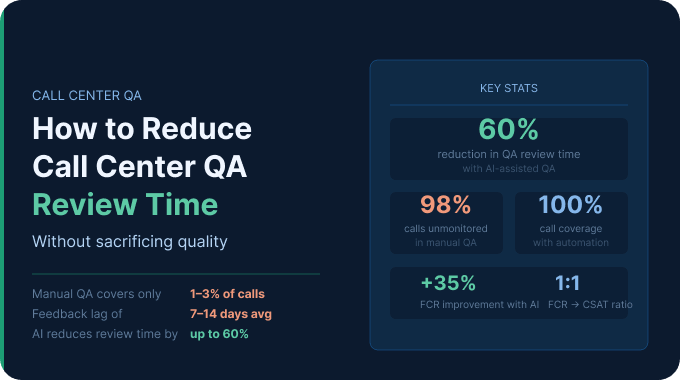
AI transforms contact center QA by reviewing 100% of interactions instead of the typical 2% manual sampling. This eliminates blind spots, cuts operational costs by 30-50%, removes scoring bias, and provides real-time feedback. Automated QA uses natural language processing to score every call, chat, and email for compliance, empathy, and resolution quality. Implementation follows a hybrid model where AI handles routine evaluation while humans focus on strategic coaching. Contact centers report 95% improvement in compliance accuracy and 25% gains in agent productivity after adopting AI-powered QA.
AI reduces manual QA by catching what your team misses in the 98% of calls they never review. Right now, you’re flying blind through thousands of daily interactions, hoping nothing catastrophic slips through your 2% sample size.
That compliance violation? The customer abuse incident? The competitor intelligence buried in the call? You’ll never know they happened.
Here’s the painful reality: manual QA doesn’t scale. Your quality team physically cannot listen to every call, read every chat, or review every email.
So you sample randomly, score subjectively, and deliver feedback weeks late when agents have already repeated the same mistakes hundreds of times.
This guide shows you how AI-powered quality assurance achieves 100% interaction coverage without hiring an army of QA specialists.
You’ll discover how natural language processing evaluates every conversation instantly, eliminates scoring bias, cuts operational costs by 30-50%, and provides real-time feedback that actually changes agent behavior.
So let’s get started!
Related: Call Center Automated QA: Process and Technologies | 2026
Automated vs. manual QA: What’s the difference?
Manual QA relies on human evaluators who randomly select a small percentage of interactions for review. A QA specialist listens to recordings or reads transcripts, then scores them against predetermined criteria. This process takes hours per evaluation and introduces subjective interpretation.
Automated QA uses AI algorithms to transcribe, analyze, and score every interaction instantly. The system applies consistent evaluation criteria across all channels without fatigue or personal bias.
Implementing automation that reduces manual QA effort transforms how quality teams operate. Here’s the fundamental contrast:
| Feature | Manual QA | Automated QA |
| Coverage | 2-5% of interactions | 100% of all channels |
| Consistency | Subjective, varies by evaluator | Objective, identical criteria |
| Speed | Hours per evaluation | Real-time analysis |
| Cost Structure | Scales with headcount | Fixed after implementation |
| Feedback Timing | Weeks delayed | Immediate post-interaction |
| Compliance Detection | Misses 95%+ violations | Flags every instance |
The global call center AI market was valued at USD 1,998.7 million in 2024 and is expected to grow to USD 7,084.7 million by 2030, growing at a CAGR of 23.8% from 2025 to 2030. This growth reflects the urgent need to move beyond manual QA’s limitations.
What are the crises of manual QA in high-volume contact centers
Manual quality assurance creates operational crises that compound as your contact center scales. The problems extend far beyond simple inefficiency.
1. The 2% sampling blind spot
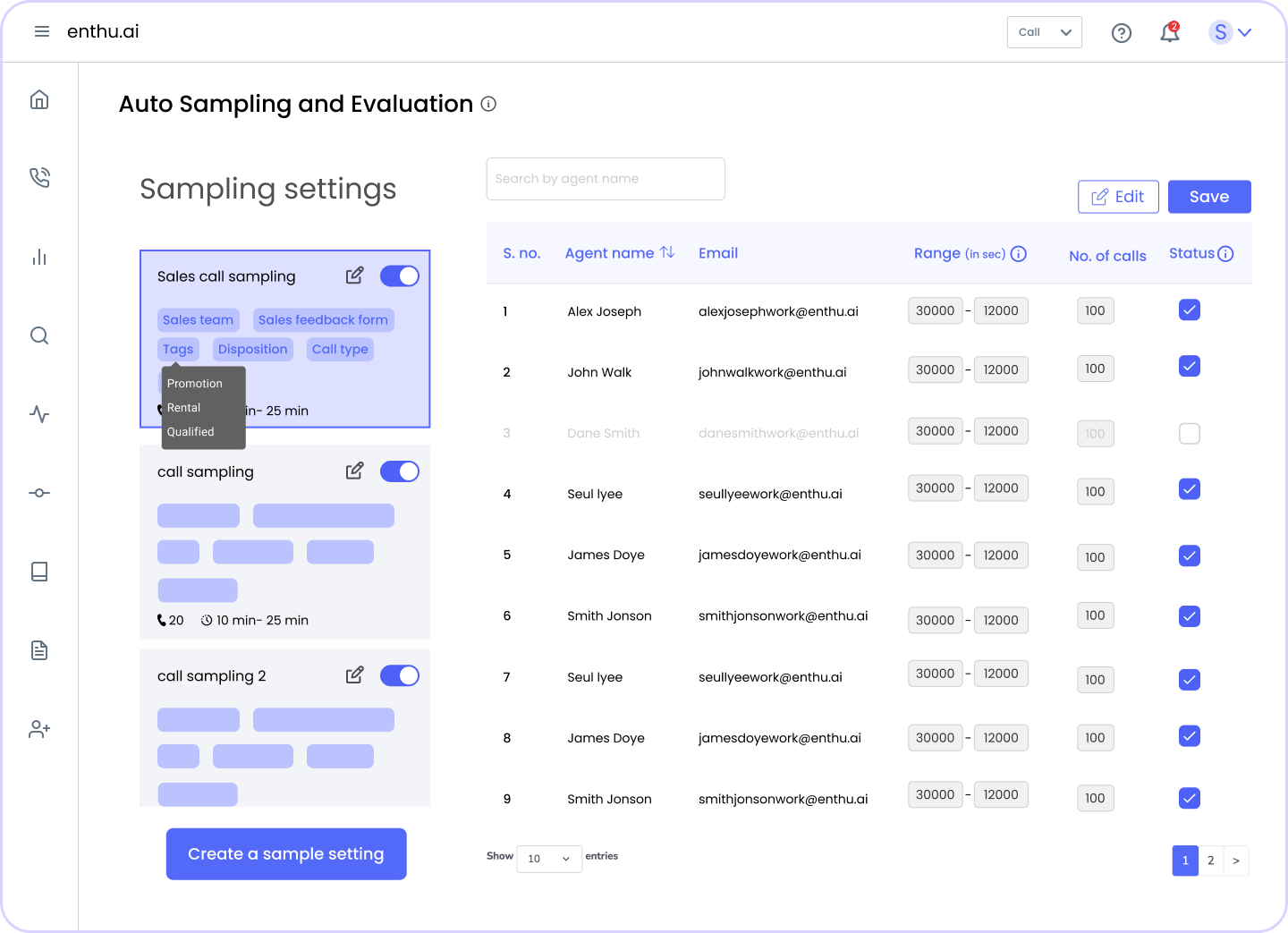
Reviewing just 2% of interactions means you’re making business-critical decisions based on a tiny, potentially unrepresentative sample. If your center handles 10,000 daily interactions, 9,800 conversations never receive quality review.
Critical compliance violations slip through undetected until they trigger regulatory penalties. Customer experience issues escalate from isolated incidents to systemic problems before you spot the pattern. Agent performance gaps widen for weeks before coaching intervention occurs.
Contact centers using full interaction monitoring saw improvement in Net Promoter Scores precisely because they eliminated these blind spots. AI technology that reduces manual QA sampling limitations enables comprehensive quality oversight.
2. High operational costs & scalability limits
Manual QA is labor-intensive by design. Each interaction requires dedicated evaluator time, creating a linear relationship between call volume and QA headcount.
When your contact volume increases 30% during peak seasons, you face an impossible choice. Either hire additional QA staff (expensive and slow) or reduce coverage percentage even further (increasing risk).
The cost savings redirect toward strategic initiatives like advanced coaching programs and agent development.
3. Subjective scoring and “calibration drift”
Human evaluators bring unconscious biases to every review. Two QA specialists scoring the same interaction often produce different results.
This subjectivity creates calibration drift where scoring standards gradually shift over time.
Agents dispute subjective evaluations, reducing trust in the QA process. Managers spend valuable time adjudicating scoring disagreements rather than coaching performance improvements. AI evaluation eliminates this variability by applying identical criteria to every interaction.
What benefits does AI-powered QA deliver to call centers?
Automated quality assurance transforms contact center operations across six critical dimensions. These improvements compound over time as your AI system learns from feedback.
1. Reducing the “feedback lag.”
Traditional QA creates a multi-week gap between agent performance and corrective feedback. By the time a coaching session occurs, the agent has already handled hundreds of similar interactions incorrectly.
AI provides immediate post-call feedback, enabling agents to correct behaviors before they become ingrained habits. This real-time loop accelerates skill development and reduces negative customer impacts.
2. Providing real-time agent assistance
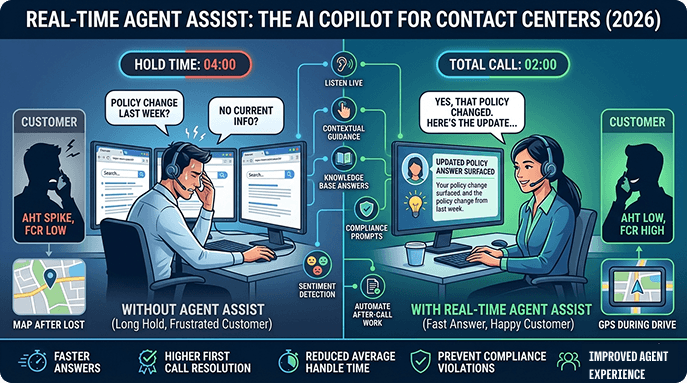
Modern AI QA platforms include real-time agent assistance that monitors live conversations. The system detects compliance risks mid-call and alerts agents to course-correct before violations occur.
Agent assist technology also surfaces relevant knowledge base articles during complex inquiries, improving first-call resolution rates by 20%. Your agents receive proactive support rather than reactive criticism.
3. Empowering agents with self-correction
Automated QA systems typically include agent portals where team members review their own scored interactions. This self-service approach enables agents to identify improvement areas independently.
You shift from a punitive QA culture to a developmental one where agents take ownership of their performance growth. This autonomy increases engagement and reduces turnover in high-stress contact center environments.
4. Reducing QA operational costs by 30-50%
Organizations implementing AI-powered QA report 30-50% reductions in quality assurance operational expenses. These savings come from eliminating manual review labor, reduced management overhead, and decreased compliance penalty risks.
One contact center documented $1 million in annual savings after transitioning to automated quality management. The ROI typically appears within 6-12 months of implementation.
5. Mitigating compliance and regulatory risk
Manual sampling leaves 95%+ of potential compliance violations undetected until regulatory audits occur. AI reviews every interaction against compliance requirements, flagging violations instantly for remediation.
Our client CallHippo reported a 20% reduction in revenue churn after adopting AI-powered QA. This comprehensive monitoring reduces regulatory penalty exposure and protects brand reputation. Omesh Makhija, VP of CallHippo, said, “Enthu has made our customer conversation data searchable. I am particularly impressed by the way Enthu helped us identify customer dissatisfaction signals and address the concerns proactively, thus reducing our churn.”
6. Improving CSAT and FCR
AI-powered QA directly improves customer satisfaction scores by ensuring consistent service quality. When every interaction receives quality review, systemic issues surface quickly for correction.
Contact centers documented 30% improvements in agent performance and 50% improvements in lead qualification rates after implementing automated QA. These gains translate directly to improved customer experience and reduced operational costs.
How does AI automate the quality assurance workflow?
Automated QA systems follow a sophisticated multi-stage process that replicates and enhances human evaluation. Understanding this workflow helps you implement AI QA effectively and see exactly how automation reduces manual QA burden across your operations.
1. Automated scoring via NLP and NLU
Natural Language Processing (NLP) transcribes conversations with speaker labels and precise timestamps. Natural Language Understanding (NLU) then analyzes the semantic meaning, detecting empathy, compliance adherence, and resolution effectiveness.
The AI assigns scores across customizable parameters like greeting protocol, script adherence, objection handling, and closing procedures. These scores generate automatically within minutes of interaction completion.
2. 100% interaction coverage across channels
AI-powered platforms analyze every call, chat, email, and social media interaction without selection bias. This omnichannel approach ensures consistent quality evaluation regardless of communication method.
Your QA team gains complete visibility into performance patterns that would never appear in 2% manual sampling. The system identifies outlier interactions automatically, prioritizing them for human review.
3. Smart tagging and trend detection
Automated QA systems apply intelligent tags to conversations based on content, sentiment, and outcome. These tags enable powerful trend analysis across teams, time periods, and customer segments.
You discover emerging issues before they escalate into widespread problems. Smart tagging also surfaces unexpected upsell opportunities and competitive intelligence that manual review would miss.
Implementing AI-driven QA in customer service: A step-by-step process
Transitioning from manual to automated QA requires a structured approach that balances technology adoption with change management. Follow these proven steps to maximize success.
Step 1: auditing your current “2% baseline”
Begin by documenting your existing manual QA coverage, costs, and outcomes. Calculate the percentage of interactions currently reviewed, average time per evaluation, and QA team size.
Identify current pain points like delayed feedback, scoring inconsistencies, or compliance gaps. This baseline establishes measurable targets for your AI implementation.
Step 2: Selecting the right “auto-QA” tooling
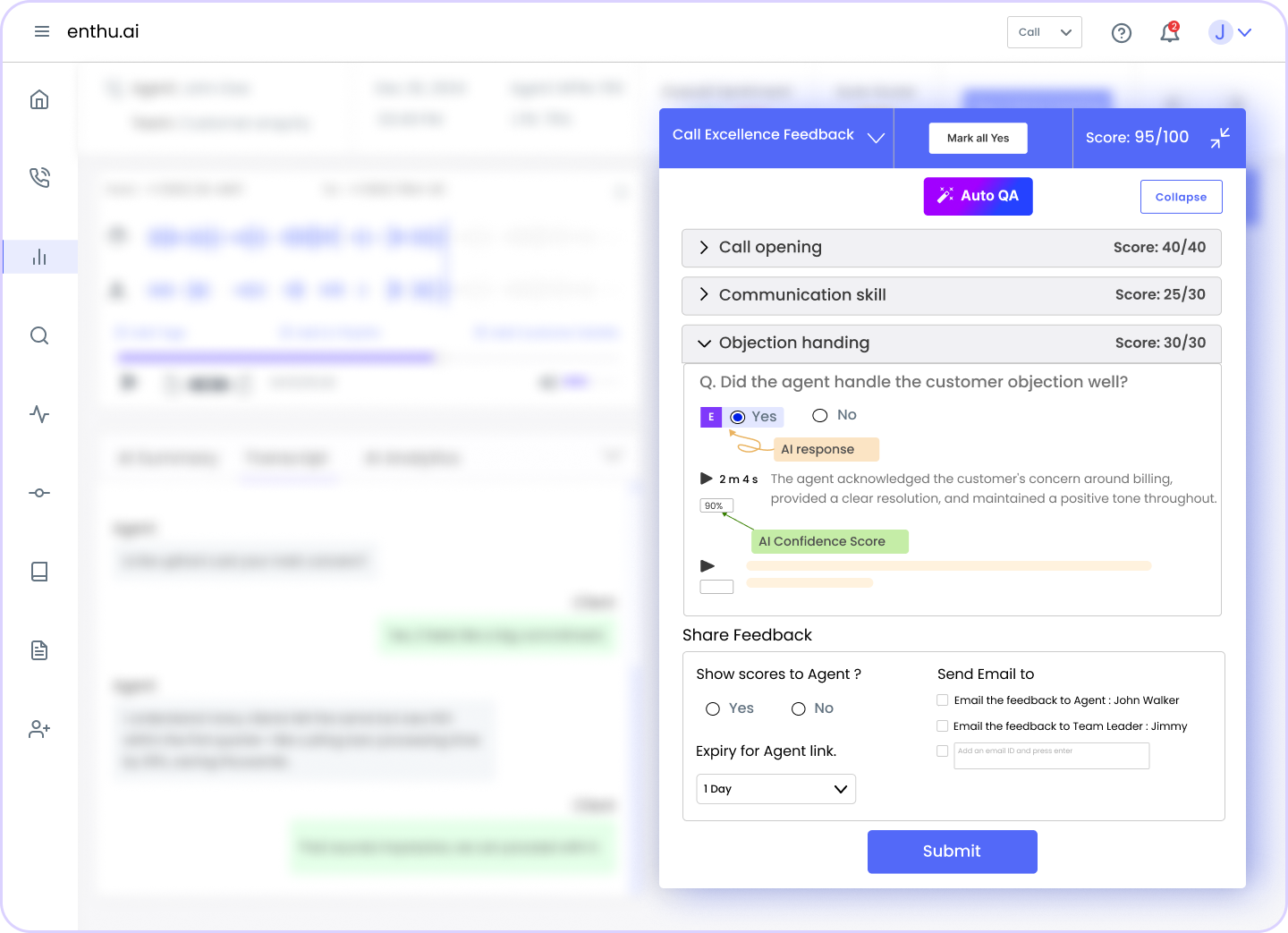
Evaluate AI QA platforms based on integration capabilities, customization options, and vendor support. The system should connect seamlessly with your existing CRM, phone system, and helpdesk platforms.
Prioritize vendors offering implementation support and ongoing model refinement. Request proof-of-concept trials with your actual interaction data before committing to enterprise deployment. The platform that reduces manual QA most effectively should demonstrate measurable time savings during trial periods.
Step 3: adopting the hybrid model
Most successful implementations follow a hybrid approach where AI handles routine evaluation while humans focus on complex edge cases and strategic coaching. This preserves human judgment for scenarios requiring contextual interpretation.
Your QA team transitions from scorers to coaches, using AI insights to guide performance improvements. This role evolution increases job satisfaction and retention among QA specialists.
Step 4: Running iterative calibration
AI models improve through supervised learning, where QA supervisors review and correct automated scores. This human-in-the-loop feedback refines the algorithm’s accuracy over time.
Plan for 30-90 days of intensive calibratio,n where you compare AI scores against expert human evaluation. Most platforms achieve 90%+ scoring accuracy alignment after this initial training period.
Step 5: Scaling across all channels
After successful pilot implementation on one channel, expand automated QA to additional communication methods. Apply lessons learned during the initial rollout to accelerate subsequent deployments.
Monitor performance metrics continuously and adjust scoring criteria as business priorities evolve. Schedule quarterly calibration reviews to prevent model drift.
Step 6: Integrating agent development programs
Connect automated QA insights directly to coaching workflows and training curricula. Use AI-identified skill gaps to create personalized agent development plans.
Track coaching impact by measuring performance improvements before and after interventions. This closed-loop system proves training ROI and identifies the most effective coaching methods.
Speed Your QA with Enthu.AI AI-powered automation
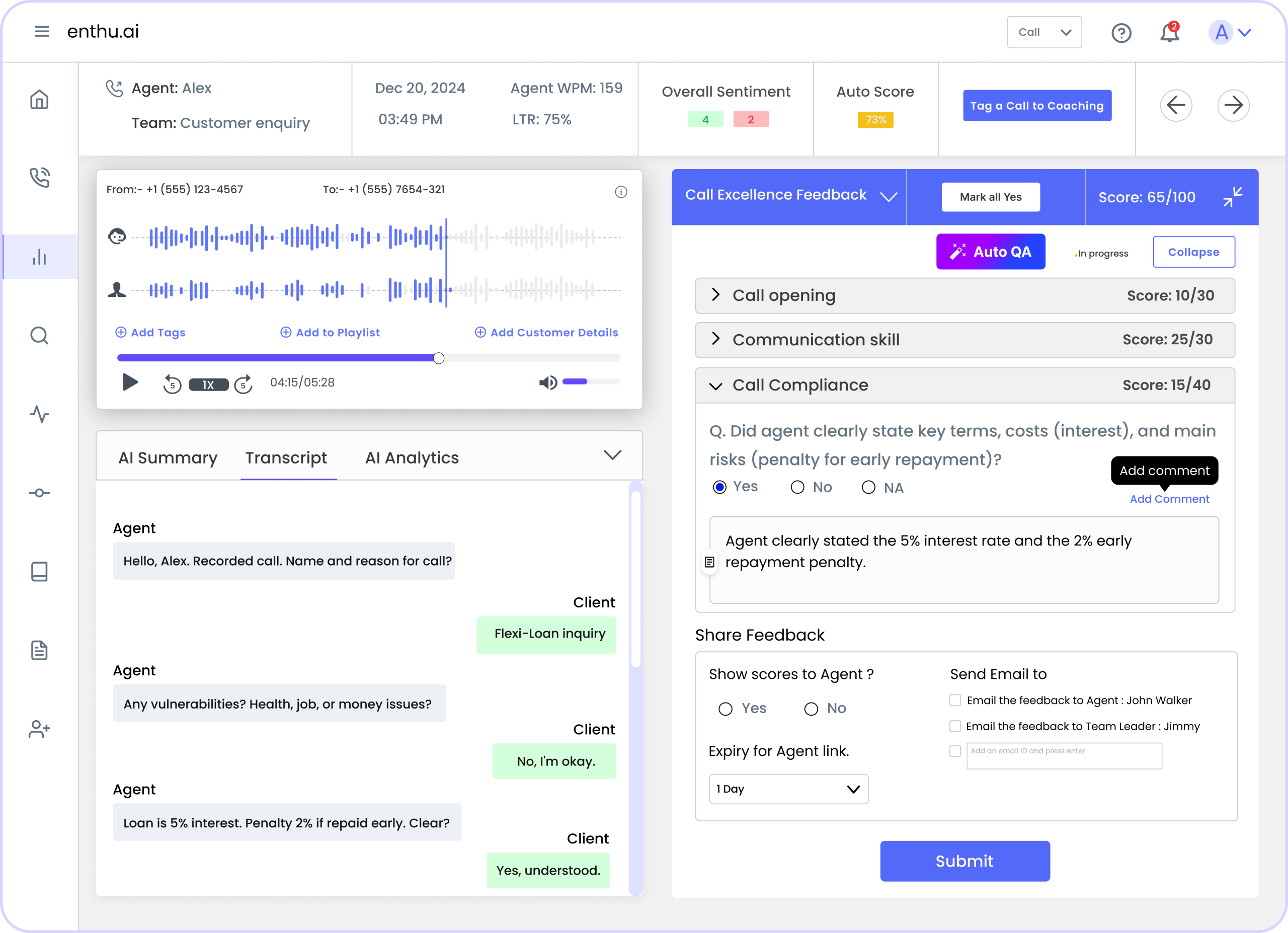
Enthu.AI delivers comprehensive automated QA through intelligent AI agents that transform contact center quality management. The platform eliminates manual review bottlenecks while maintaining the human oversight necessary for nuanced evaluation.
- Transcript Agent captures every conversation with speaker labels and precise timestamps, creating searchable records for instant review.
- QA Agent automatically scores 100% of interactions across customizable parameters including empathy, compliance adherence, script following, and resolution quality.
- Summary Agent generates concise interaction summaries that extract key points, customer concerns, and next steps.
- Reporting Agent creates real-time dashboards highlighting performance trends, compliance risks, and improvement areas.
- Compliance Agent monitors every interaction for regulatory violations, flagging issues immediately for remediation.
Enthu.AI integrates with 30+ platforms including major phone systems, CRMs, and helpdesk solutions.
Contact centers using Enthu.AI report 90% reductions in compliance review time and 5% improvements in appointment set rates. The platform reduced new agent onboarding time by 50% through efficient, data-driven coaching at one organization.
FAQs
1. How does AI reduce manual QA work in contact centers?
AI automates interaction transcription, scoring, and analysis across 100% of conversations. This eliminates time-consuming manual review while providing consistent, objective evaluation. QA teams shift focus from scoring to strategic coaching and model refinement.
2. What percentage of interactions can AI QA systems review?
AI-powered QA platforms analyze 100% of interactions across all channels in real time. This represents a 50x improvement over typical manual QA coverage of 2-5%. Complete coverage eliminates blind spots that hide compliance risks and customer experience issues.
3. Does automated QA replace human QA specialists completely?
No, successful implementations use a hybrid model where AI handles routine evaluation while humans focus on complex cases and strategic coaching. QA specialists train AI models, handle edge cases requiring contextual judgment, and develop agent improvement programs.
4. How long does AI QA implementation typically take?
Implementation timelines range from hours to weeks depending on system complexity. Proof-of-concept deployments often complete within 30 days, while enterprise-wide rollouts across multiple channels may require 90-180 days including calibration periods.
5. What ROI can contact centers expect from automated QA?
Organizations report 30-50% reductions in QA operational costs and $1 million+ annual savings. Additional benefits include 95% compliance accuracy improvements, 25% agent productivity gains, and 20% first-call resolution increases. ROI typically appears within 6-12 months of implementation.

 On this page